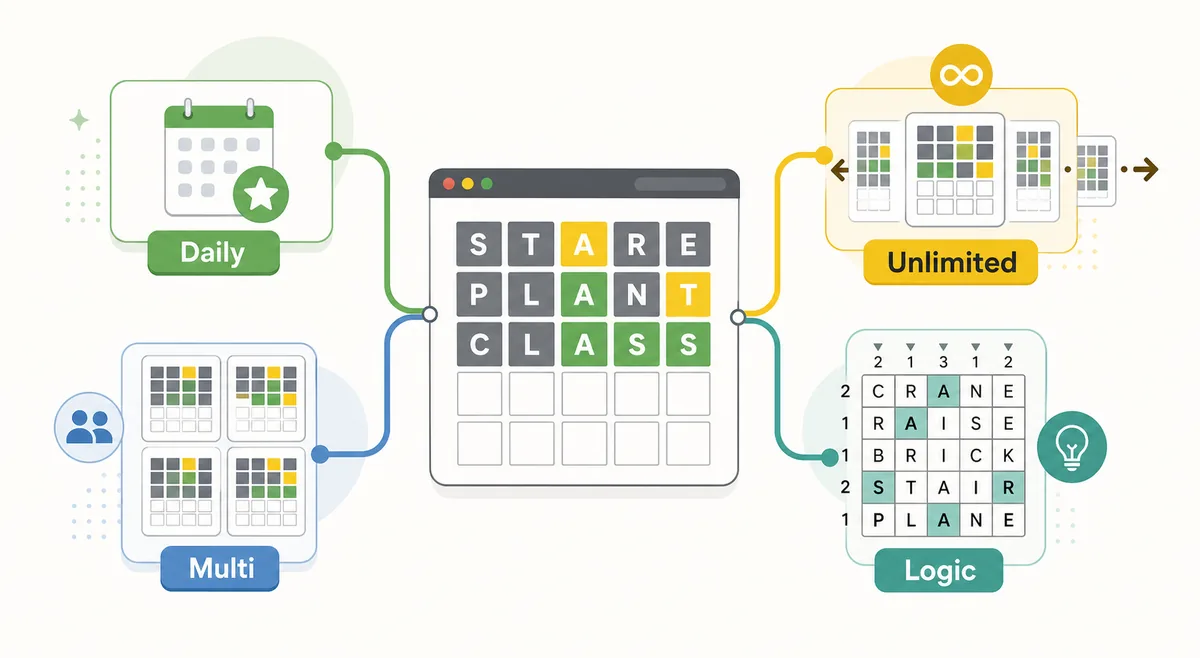
The best Wordle like game depends on what you want next
The best Wordle like games are not all trying to replace the original daily Wordle. Some are better for a two-minute warmup, some help you practice without a daily limit, and some add pressure by asking you to solve several boards at once. That difference matters because a player searching for “games like Wordle” usually wants a playable next step, not a history lesson.
For most Wordless players, the cleanest path is simple: use Daily Wordless or the official Wordle for one short puzzle, open Wordle Unlimited when you want more rounds, use Wordle Infinite to test starting words, try Quordle when one board feels too easy, and pick Waffle or a crossword-style word grid when you want deduction instead of pure guessing.
This guide separates each option by intent. It also avoids presenting generated illustrations as real game screenshots. The images on this page are editorial explainers; the source links point you to official game pages when you want to play or verify the original experience.
Wordle like games compared by intent
Use this table first. It saves time because the right recommendation changes depending on whether you want speed, practice, difficulty, sharing, or a different puzzle structure.
| Game type | Best fit | Why it works | Start here |
|---|---|---|---|
| Daily word puzzle | A short return habit | One puzzle keeps the session focused and makes streaks meaningful. | Daily Wordless or official Wordle |
| Unlimited Wordle-style play | More rounds after the daily puzzle | You can restart, test openings, and keep practicing clue reading. | Wordle Unlimited |
| Infinite practice | Learning strategy | Back-to-back boards make it easier to compare CRANE, SLATE, RAISE, and other starts. | Wordle Infinite |
| Custom challenge | Friends, classrooms, groups | A creator chooses the hidden word and shares a private challenge link. | Custom Wordle |
| Multi-board challenge | Harder Wordle-style logic | Several boards share guesses, so each word must carry more information. | Quordle-style games |
| Logic word grid | Deduction over guessing | The puzzle adds placement, crossing, or swap rules beyond green/yellow/gray clues. | Waffle-style games |
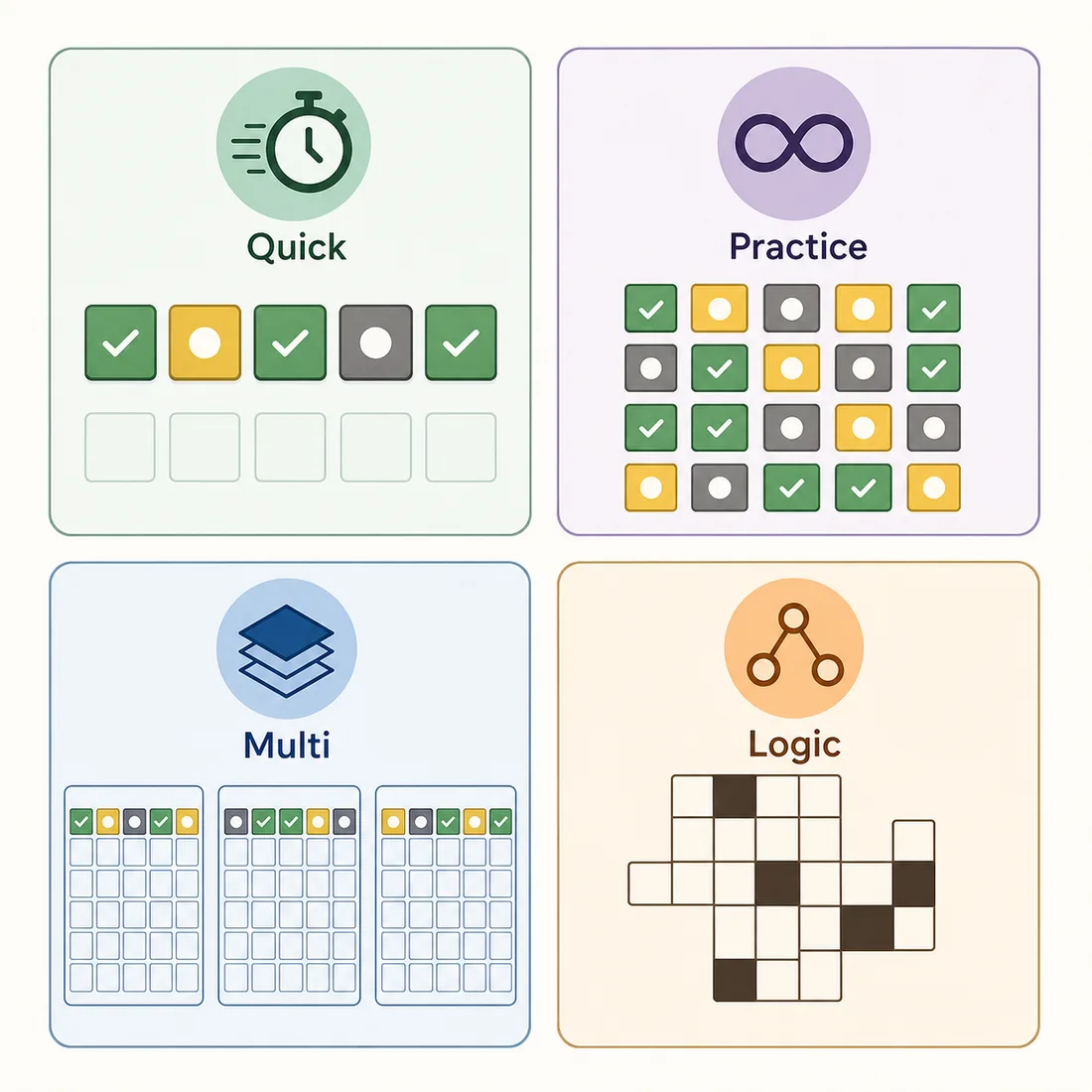
1. Daily Wordless and official Wordle for a quick puzzle
Choose a daily word puzzle when you want a short, repeatable challenge. The daily format works because it creates a natural stopping point: solve, share, and come back tomorrow. It is also the easiest format to fit into a morning routine or a short break.
Wordless keeps this intent at the top of the site with a playable board and adjustable word lengths. The official Wordle remains the cultural reference point, but Wordless adds 3-8 letter options and nearby modes so you can continue without changing sites.
- Best for: one focused puzzle and a simple streak habit.
- Use Wordless when you want flexible word length or a browser-only alternative.
- Use the official Wordle when you specifically want the New York Times daily puzzle.
2. Wordle Unlimited and Wordle Infinite for more rounds
Unlimited and infinite modes answer a different search intent from the daily puzzle. Players are not asking for a new brand; they want the same familiar clue logic without waiting 24 hours. That makes these pages strong support for searches such as “wordle like games unlimited” and “free games like Wordle”.
The main benefit is learning. One daily board is too small a sample to judge a starting word. Ten fast boards make patterns visible: which opener usually creates a clear second guess, which letters you overuse, and when a high-information guess is better than an immediate answer attempt.
- Best for: practice sessions, classroom warmups, and testing openings.
- Watch for: fatigue. After many rounds, careless guesses can teach bad habits.
- Internal next step: use Wordle Infinite for strategy testing and Wordle Unlimited for casual no-wait play.
3. Quordle-style games when one board feels too easy
Multi-board games make every guess do more work. Instead of solving one hidden word, you are often managing several boards with the same guesses. That raises the difficulty quickly because a word that helps one board may waste information on another.
This format is best after you already understand normal green, yellow, and gray clues. If you still struggle with the basic six-guess rhythm, practice on Wordless first. If you often solve the daily puzzle in three or four guesses, a multi-board variant can add meaningful pressure without changing the core vocabulary skill.
- Best for: experienced players who want harder deduction.
- Avoid when: you only have two minutes or want a relaxed puzzle.
- Helpful habit: track the board with the fewest remaining guesses first.
4. Waffle-style and grid games when you want a different rule set
Some Wordle alternatives are not just more Wordle. Waffle-style grids, crossword-like word puzzles, and letter-placement games shift the challenge from guessing a hidden answer to arranging letters under constraints. These are better when your brain wants a logic puzzle rather than another elimination board.
The tradeoff is that the learning curve can be steeper. A new rule set may feel slower for the first few rounds, but it can stay interesting longer because the solution path depends on structure, not only vocabulary frequency.
- Best for: players who like deduction, placement, and grid logic.
- Avoid when: you specifically want the classic Wordle clue rhythm.
- Good pairing: solve one Wordless board, then switch to a grid game for variety.
5. A simple routine for word puzzle variety
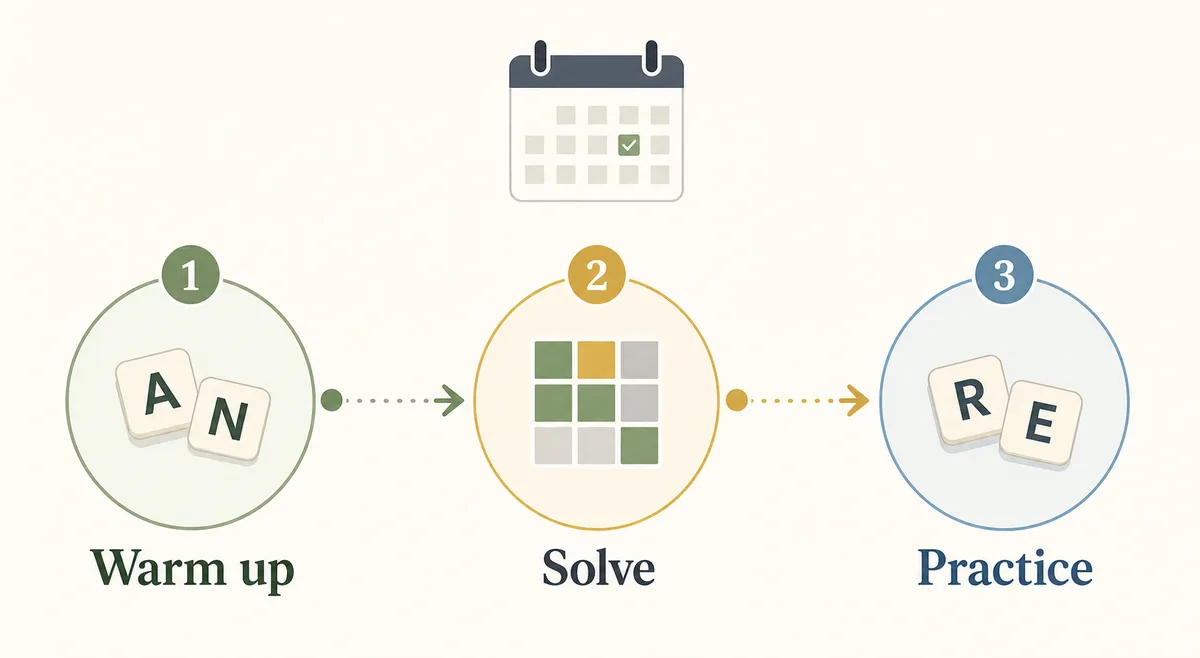
A useful routine prevents choice overload. Start with a daily board, then decide whether you want speed, learning, or a harder challenge. If you want speed, play one unlimited round. If you want learning, test a starting word across several infinite boards. If you want difficulty, move to a multi-board or logic variant.
This routine also protects the original appeal of Wordle-like games: short sessions with clear feedback. When every option becomes a long marathon, the puzzle stops feeling sharp. Treat alternatives as a menu, not a required checklist.
- Warm up: play one daily or short Wordless board.
- Solve: use normal clue logic and avoid random guesses.
- Practice: switch to infinite, unlimited, multi-board, or logic mode only if you still want more.
How to choose without cannibalizing your own play time
If you are choosing for fun, pick the game that matches your mood. If you are choosing for improvement, pick the game that trains the weakest part of your solve. Miss common vowels often? Practice balanced starts. Struggle under pressure? Try unlimited rounds with a fixed opening word. Solve too easily? Add a multi-board challenge.
For Wordless.blog, this keyword also has a clear internal role. The page should not replace Wordle Unlimited, Wordle Infinite, Custom Wordle, or the Solver. It should guide players to the right mode and keep each existing page focused on its own intent.
FAQ about Wordle like games
What are the best Wordle like games?
For most players, start with Daily Wordless or official Wordle, then use Wordle Unlimited for more rounds, Wordle Infinite for practice, Custom Wordle for sharing, Quordle-style games for difficulty, and Waffle-style games for logic.
Are games like Wordle free?
Many browser word games are free to play, including Wordless modes. Always check the official page for the specific game because ownership, ads, and access rules can change.
What is a good Wordle alternative for practice?
Wordle Infinite is a good practice option because you can solve several boards in one session and compare how different starting words perform.
Which Wordle like game is hardest?
Multi-board games are usually harder than a single daily board because one guess affects several answers. Logic-grid variants can also be difficult because they add placement rules.
Should I use a solver with Wordle alternatives?
Use a solver as a learning tool, not as a replacement for solving. It is most helpful after one or two guesses when you want to understand why certain next words are stronger.