The best Wordle strategy is a decision process, not one lucky word
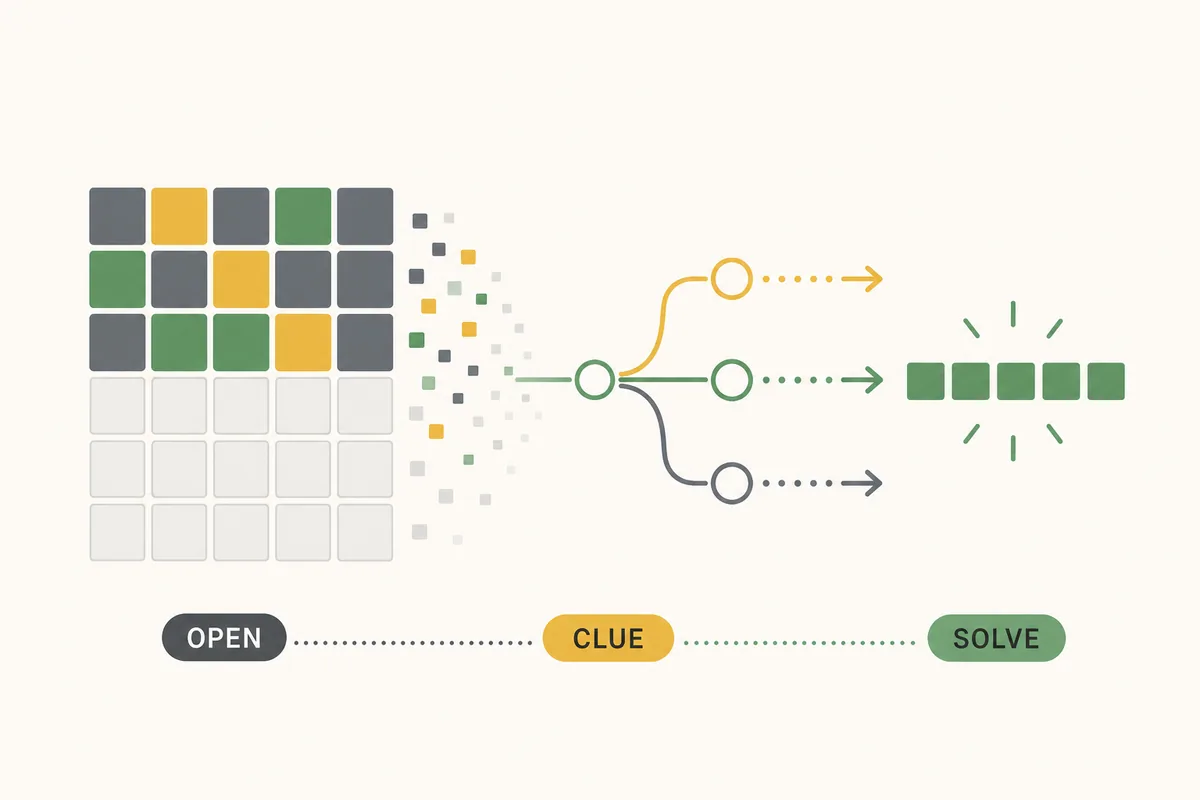
A reliable Wordle strategy starts with a balanced opener, but the real improvement happens after row one. Use the first guess to collect information, lock green letters in place, move yellow letters to new positions, remove gray letters unless a repeat is possible, and make the next guess test something specific. That process works for official Wordle-style puzzles and for Wordless modes with 3-8 letter words.
If you want one simple rule, use this: every guess should either find new letters, test a likely pattern, or confirm the final answer. Random guesses waste the six-row limit. Repeating letters too early can also waste information unless the clue already suggests a double letter. The strongest players are not just memorizing words; they are reducing the possible answer space after each clue.
This guide keeps the boundary clear. For a pure list of opening words, use the best starting words page. For clue filtering after you are stuck, use the Wordle Solver. This page explains the human strategy that connects those two steps.
Wordle strategy decisions compared by game stage
Use the table as a quick checklist. It separates the job of each row so you do not treat every guess like another opening word.
| Stage | Best move | Why it works | Common mistake |
|---|---|---|---|
| First guess | Use a balanced word with common vowels and consonants. | It creates useful green, yellow, and gray evidence quickly. | Starting with repeated letters before you have evidence. |
| Second guess | Move yellow letters, keep greens, and test new consonants. | The second row should shrink the answer space, not just chase one guess. | Reusing gray letters without a repeat-letter reason. |
| Middle rows | Compare likely word patterns such as _IGHT, _OUND, or _A_ER. | Pattern thinking turns scattered clues into a short candidate list. | Ignoring word shape and only counting letters. |
| Late rows | Choose between candidate answers with a separator word when allowed. | A separator can distinguish BOUND, FOUND, HOUND, and SOUND before the final try. | Guessing one candidate too early when several remain. |
| Hard mode | Follow clue constraints while still seeking new information. | Hard mode rewards disciplined clue use and punishes careless filler words. | Locking into a narrow path before testing enough letters. |
1. Pick a strong opener, then stop worshipping the opener
A good opener gives you broad information. CRANE, SLATE, RAISE, STARE, TRACE, and ROATE-style words are popular because they test common letters without repeating too soon. In Wordless, the exact best opener can change by word length, so your goal is not to find one perfect word for every board. Your goal is to get a useful clue pattern quickly.
For five-letter puzzles, start with two vowels and three common consonants, or one vowel plus very strong consonants if you prefer a tighter pattern. For 3-letter puzzles, every slot matters immediately. For 7-8 letter puzzles, pay attention to chunks such as ING, TION, ER, ST, CH, and LY because longer words often reveal structure before they reveal the full answer.
The information gain over many generic Wordle tips is this: judge an opener by the quality of your second guess, not by whether it occasionally wins in one row. If the opener often leaves you with no clear next move, it is not the best Wordle strategy for your play style.
- Use one familiar opener when you want a consistent daily routine.
- Rotate two or three openers in Wordle Infinite when you want practice data.
- Avoid repeated letters in row one unless you are deliberately testing a known pattern.
2. Convert green, yellow, and gray clues into constraints
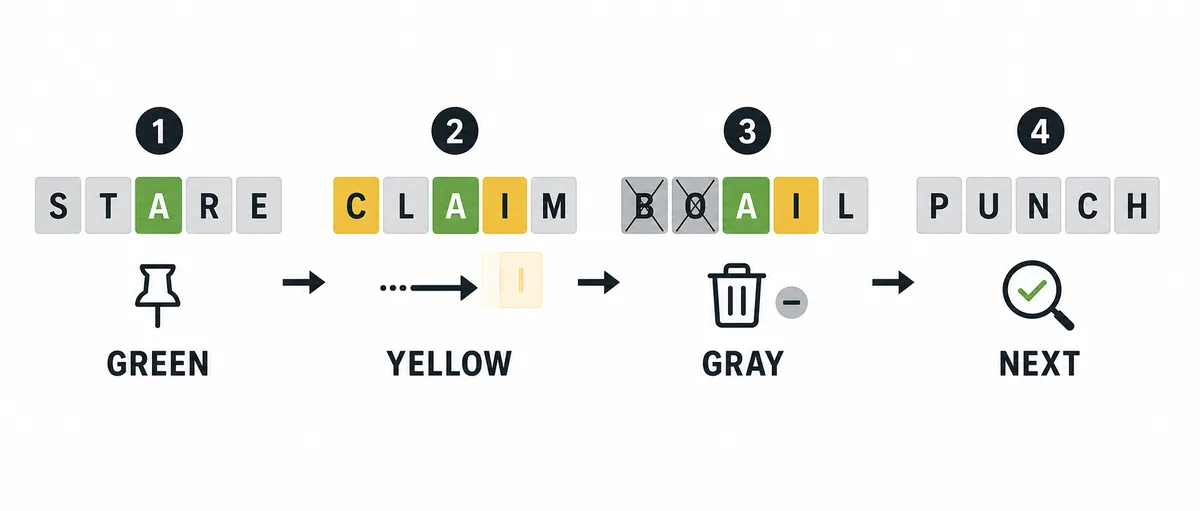
The biggest strategy jump comes from treating colors as constraints. A green tile is fixed. A yellow tile is present but must move. A gray tile is absent in most cases, but be careful: if the answer has one copy of a letter and your guess had two, one copy may turn gray while the other copy gives a clue. That is why repeated-letter logic should be handled deliberately instead of emotionally.
After each row, write the board in plain rules: A is in position 3, R is not position 2, T is not in the word, E may still be possible at the end. This mental translation prevents the common mistake of seeing a yellow tile and simply dragging it to the next random spot.
If you are playing fast, use a smaller version of the same process. Say the fixed letters first, then the movable letters, then the banned letters. That order keeps you from building a candidate word that violates your own clue evidence.
- Green: keep the letter in that exact slot.
- Yellow: include the letter, but test a different slot.
- Gray: remove it unless duplicate-letter evidence says otherwise.
3. Give the second guess one clear job
The second guess is where most Wordle strategy succeeds or fails. If row one has few clues, the second guess should test new high-frequency letters. If row one has two or three useful clues, the second guess should place those clues into a plausible word shape. Mixing both goals is fine, but only when the word still respects the evidence.
For example, if STARE gives a yellow A and a green E at the end, a second guess should try A in a new position while keeping E fixed, such as a word pattern that tests different consonants. If CRANE gives only gray C, R, N and yellow A/E, do not keep playing words built around those gray consonants. Use a fresh word that moves A and E while testing S, T, L, P, or D.
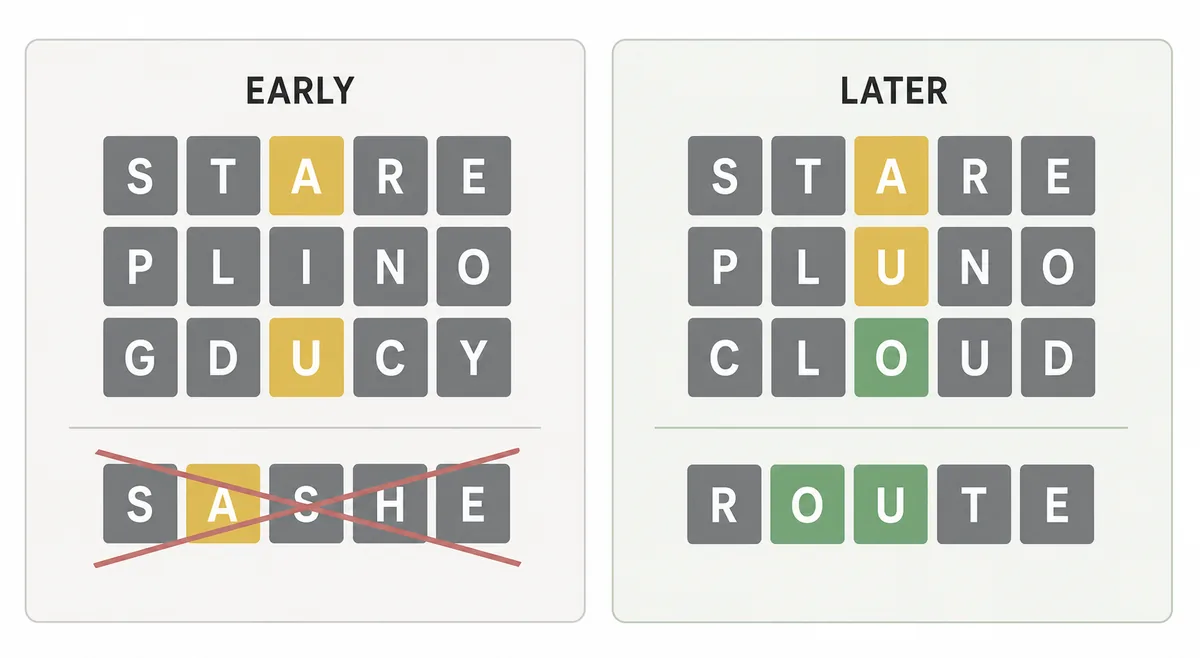
A useful separator word can be better than a near-answer in the middle rows. If you are choosing between several candidates that share a pattern, a separator tests the letters that distinguish them. This is especially useful outside strict hard mode, where you are allowed to play an information word that cannot itself be the final answer.
- Low clue opener: test new letters.
- Good clue opener: build a plausible pattern.
- Several candidates left: consider a separator word before the final guess.
4. Handle repeated letters after you have evidence
Repeated letters are real, but early repeated-letter guesses are expensive. A word like EERIE or MAMMA can be correct on the right day, yet it usually tests fewer unique letters. In the first two rows, unique-letter coverage often gives more information unless the board already points toward a double letter.
The right time to test a repeat is when the clue pattern suggests it. If you have a green O and most normal patterns are gone, words like BLOOM, SCOOP, or ROOMY-style structures become worth checking. If one copy of a letter is yellow and another copy came back gray in the same guess, the puzzle may be telling you there is exactly one copy.
This is a place where humans often outperform simple memorized tips. You are not asking, “Do Wordle answers have double letters?” They do. You are asking, “Has this board earned a repeat-letter test yet?” That question saves guesses.
- Do not spend row one on a double unless you have a specific reason.
- Treat mixed duplicate clues carefully: one yellow plus one gray can mean exactly one copy.
- Use repeat-letter guesses late when normal candidate words no longer fit.
5. Adjust the strategy for hard mode and Wordless practice
Hard mode changes the strategy because you must reuse revealed clues. That makes discipline more important. You cannot freely play a separator word that ignores a green or yellow clue, so your opener and second guess need to preserve enough flexibility. A too-narrow guess can trap you in a family of similar answers.
Wordless practice helps because you can test the same decision process across many boards. Use Wordle Infinite to compare how often an opener creates a clean second move. Use Wordle Unlimited when you want a no-wait rhythm. Use Custom Wordle for a classroom or friend challenge where the goal is explaining clue logic rather than chasing a daily answer.
For 3-8 letter modes, scale the strategy instead of abandoning it. Short words need direct slot testing. Five-letter boards reward balanced frequency. Longer words reward chunks, endings, and affixes. The colors stay the same, but the clue value changes with word length.
- Hard mode: obey known clues and avoid narrowing too fast.
- Infinite mode: test whether a strategy works across several rounds.
- Longer words: think in chunks as well as individual letters.
6. A simple solve example you can copy
Start with SLATE. Suppose S, L, and T are gray, A is yellow, and E is green at the end. Your rule set is now: the answer ends in E, contains A not in position 3, and probably does not contain S, L, or T. A poor second guess would reuse several gray letters because it feels familiar. A stronger second guess moves A and tests new consonants.
Now imagine the second guess gives a green A in position 2 and a yellow R. You can build a pattern like _A__E with R somewhere else. At this point, list candidates mentally instead of guessing the first word that appears. If several candidates share the same shape, use a word that separates their key letters when the rules allow it.
This example is intentionally not tied to today’s official Wordle answer. Evergreen strategy pages should not depend on a date-specific puzzle because that intent changes every day and quickly becomes stale.
- Translate the row into rules.
- Choose the next guess by job, not by habit.
- Use candidate comparison before the last two guesses.
7. The mistakes that make good players lose rows
The most common mistake is emotional guessing. A word “feels right,” so the player submits it even though it repeats gray letters or leaves yellow letters in the same place. Another mistake is overvaluing the first word. Strong openers help, but they cannot rescue a second or third guess that ignores evidence.
A quieter mistake is waiting too long to solve. Information words are useful, but the puzzle still has only six rows. Once the candidate set is small and one answer explains all clues, switch from exploring to solving. Good Wordle strategy is not endless analysis; it is knowing when the evidence is enough.
Finally, do not let a solver replace the learning loop. A solver is useful when you want to audit a board or learn why a guess is strong. For daily play, try your own constraint process first, then use the solver as a review tool.
- Do not keep yellow letters in the same wrong slot.
- Do not reuse gray letters without a duplicate-letter reason.
- Do not play information words after the answer is already clear.
FAQ about Wordle strategy
What is the best Wordle strategy?
The best Wordle strategy is to use a balanced opener, translate colors into constraints, make the second guess test a clear idea, and switch from information gathering to solving when the candidate list is small.
What is the best first word for Wordle strategy?
CRANE, SLATE, RAISE, STARE, and TRACE are strong starting choices because they test common letters. The best first word is the one that consistently gives you a useful second guess.
Should I use a Wordle solver as part of my strategy?
Use a solver as a learning aid after you have tried your own clue logic. It can show candidate words and help explain why a next guess is stronger, but relying on it for every row reduces practice value.
How does Wordle hard mode change strategy?
Hard mode forces you to reuse known green and yellow clues, so separator words are limited. Choose openers and second guesses that keep enough flexibility while obeying the revealed clues.
Are repeated letters good Wordle strategy?
Repeated letters are useful when the clue pattern supports them, but they are usually poor early guesses because they test fewer unique letters. Save repeat-letter tests for boards that have earned them.