Wordle Hard Mode means every revealed clue must be used again
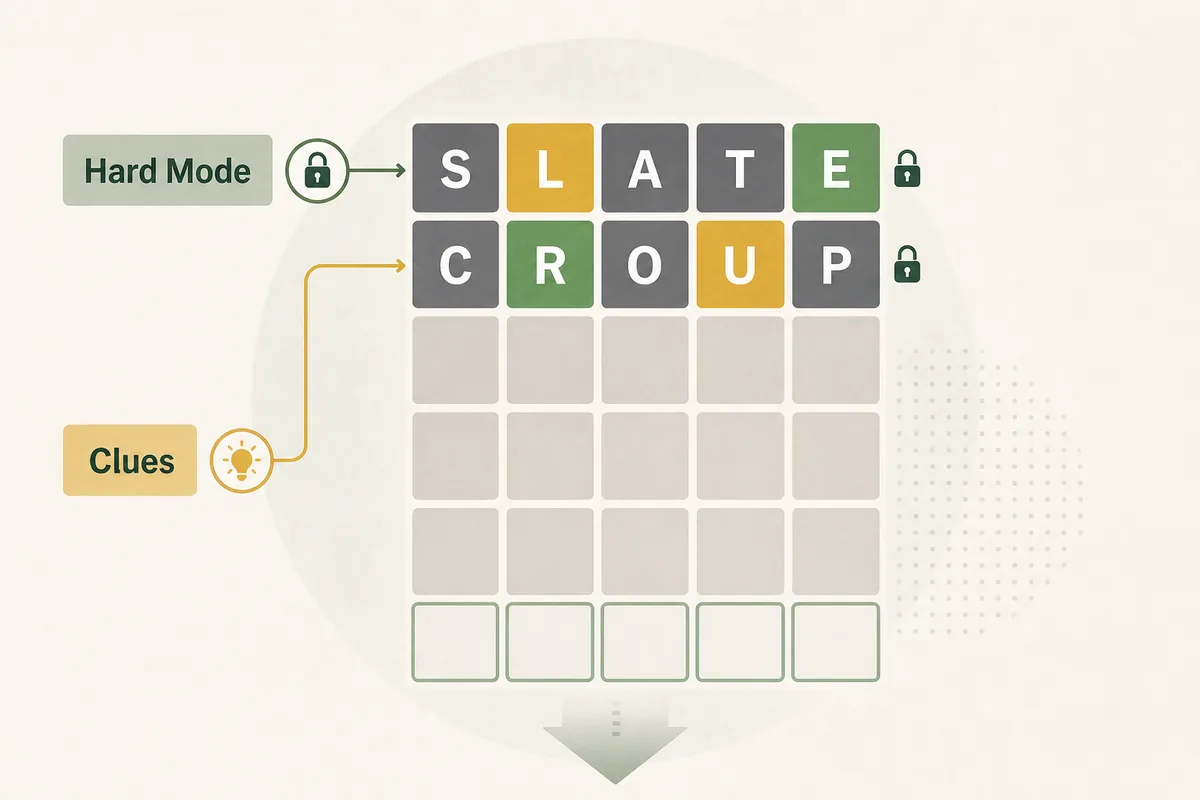
Wordle Hard Mode is a setting that forces you to keep using revealed clues. If a letter turns green, that letter must stay in the same position in later guesses. If a letter turns yellow, later guesses must include that letter somewhere, but not necessarily in the same slot. Gray letters are still usually avoided, although duplicate-letter cases require judgment.
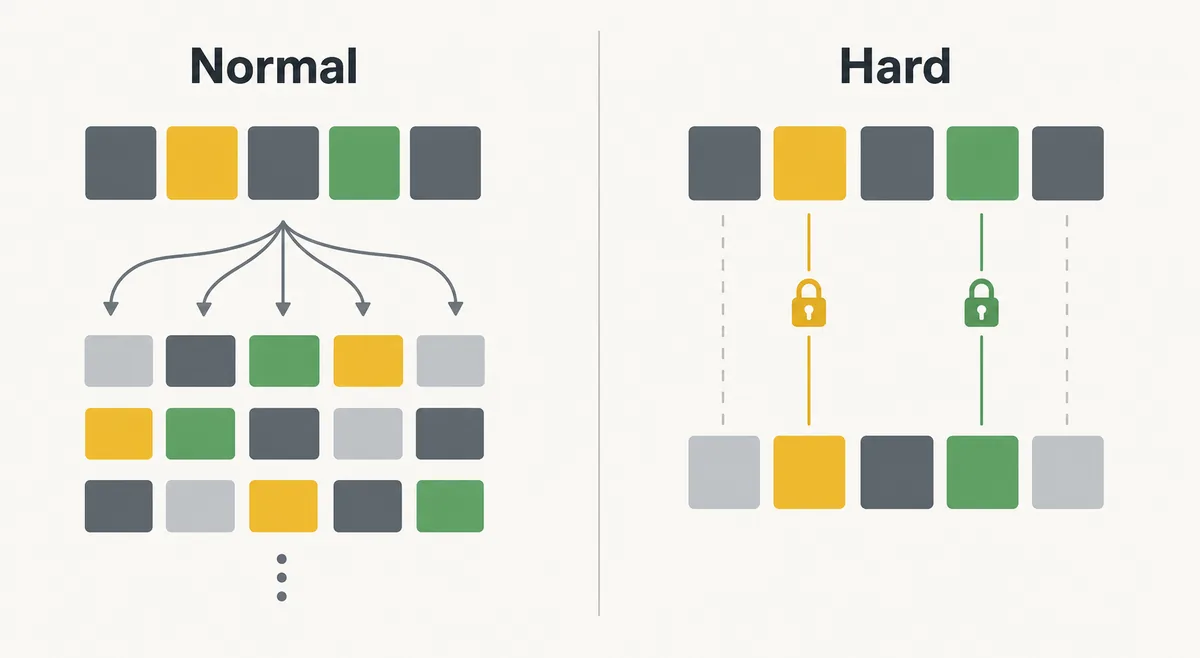
The mode does not make the secret answer longer, reduce the six-guess limit, or change the color system. It changes your freedom. In normal mode you can play a throwaway separator word to test several new letters. In Hard Mode you must respect the information you already revealed, so every guess has to be both legal and useful.
This makes Wordle Hard Mode a good fit for players who already understand green, yellow, and gray clues and want cleaner discipline. Beginners can still use it, but they should learn the normal rules first. If you want broad strategy, read the Wordle Strategy guide; if you are stuck on a clue pattern, use the Wordle Solver as a review tool rather than a replacement for thinking.
Normal mode vs Wordle Hard Mode
The key difference is not puzzle difficulty in the dictionary sense. It is constraint management: Hard Mode removes guesses that ignore known evidence.
| Decision | Normal mode | Hard Mode | Practical effect |
|---|---|---|---|
| Green clue | You can ignore it in an information guess. | You must keep it in that position. | Late guesses become more disciplined. |
| Yellow clue | You can omit it temporarily. | You must include it somewhere. | Separator words are harder to use. |
| Gray clue | Usually avoided, but still playable. | Usually avoided, with duplicate-letter caution. | The game does not solve duplicate logic for you. |
| Second guess | Can test a completely fresh word. | Must obey revealed clue constraints. | A weak opener can trap you faster. |
| Best player fit | Good for learning and broad testing. | Good for disciplined clue use. | Choose based on how much freedom you want. |
1. Wordle Hard Mode rules in plain English
The rule is simple: revealed hints must be used in later guesses. A green letter is fixed. A yellow letter is required, though it must move away from the position where it was yellow. That is why Hard Mode often feels stricter after the first or second row, not on the opening guess.
For example, if SLATE gives a green E at the end and a yellow A, your next guess must end in E and include A somewhere else. A word that ignores the E is illegal in Hard Mode, even if it would have tested useful new letters. A word that drops the yellow A is also illegal.
The tricky part is duplicate letters. If your guess uses two copies of a letter and only one receives a color clue, the board may be telling you that the answer contains one copy, or it may leave a second copy possible depending on the exact clue pattern. Do not treat every gray duplicate as a simple ban without checking the colored copy.
- Green means fixed: same letter, same position.
- Yellow means required: include the letter in a different possible position.
- Gray usually means absent, but duplicate-letter clues need careful reading.
2. A 5-step Wordle Hard Mode strategy
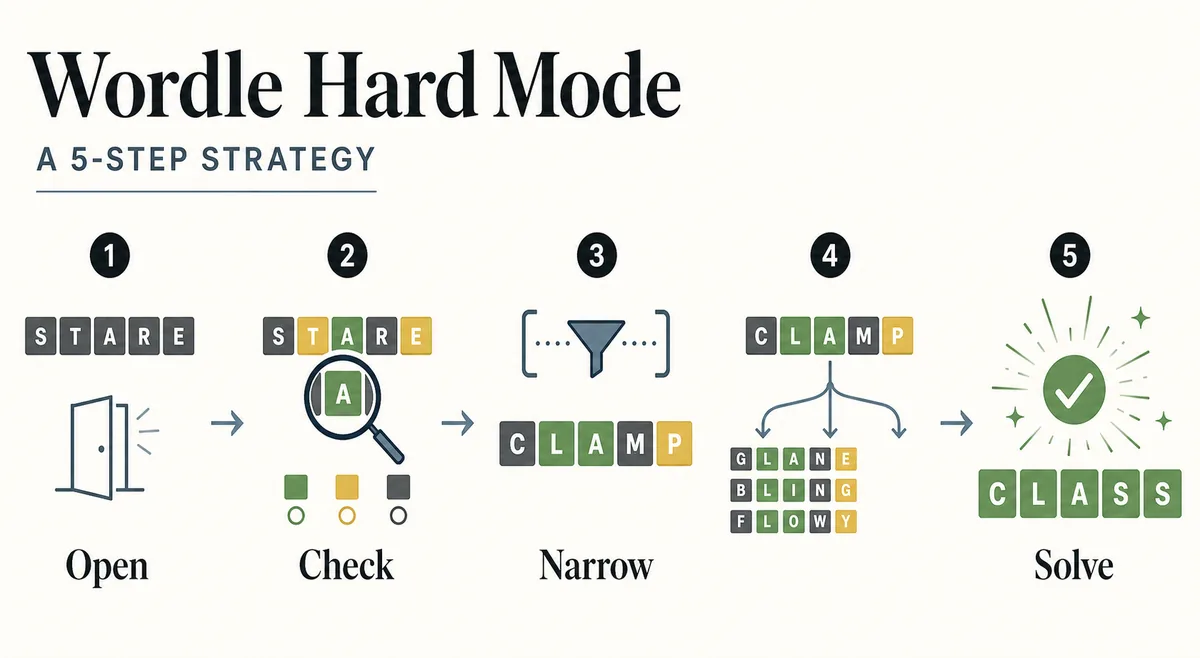
Start with an opener that leaves flexible follow-ups. CRANE, SLATE, STARE, RAISE, and TRACE-style words work because they test common letters without repeating too early. In Hard Mode, the opener matters because any useful clue becomes a rule you must obey.
Second, translate the board into constraints before typing the next word. Say the fixed letters first, then the required movable letters, then the letters you should avoid. This small pause prevents the most common Hard Mode mistake: building a word that looks plausible but violates a yellow or green clue.
Third, keep testing new information inside the constraints. A legal Hard Mode guess can still be weak if it only rearranges letters you already know. When several candidate answers remain, choose a word that separates the candidates while obeying every clue. If strict Hard Mode blocks the perfect separator, choose the best legal separator instead.
- Open with broad coverage, not repeated letters.
- Convert colors into rules before each guess.
- Use legal separator words when several answers share a pattern.
3. Mistakes that make Hard Mode feel unfair
The first mistake is choosing an opener that creates a narrow trap too soon. If your first two rows lock you into a pattern like _IGHT, you may face several possible answers with too few legal separator options. Hard Mode did not become impossible; the early guesses made the remaining decision expensive.
The second mistake is chasing the answer before the evidence is strong. Players often see one green tile and immediately try a near-answer. That can work, but it also burns rows when many candidates fit. In Hard Mode, a near-answer should still test something useful unless you are ready to solve.
The third mistake is misunderstanding yellow letters. A yellow clue says the letter is in the answer, not that it should be moved to the first new slot you see. Check all possible slots against normal English word shape before locking your next guess.
- Do not overcommit to a common ending before testing enough letters.
- Do not guess near-answers when several legal candidates remain.
- Do not move a yellow letter randomly; test a plausible word shape.
4. When to turn on Wordle Hard Mode
Turn on Hard Mode when you want practice with discipline. It is especially useful after you already know how color clues work because it forces you to respect your own evidence. It can also make unlimited or infinite puzzle practice more meaningful: each board becomes a test of whether your second guess actually follows the clues.
Leave Hard Mode off when you are teaching a new player, testing opening words, or using a deliberate information word that ignores an early clue. Normal mode gives more room to learn. Hard Mode gives more accountability once the basics are comfortable.
For Wordless players, the same idea applies across 3-8 letter puzzles. Shorter words leave less space for experiments, while longer words reward chunk thinking. Hard Mode does not change the goal; it changes how carefully each clue must be carried forward.
- Use Hard Mode for disciplined practice.
- Use normal mode when testing openers or teaching rules.
- In longer Wordless boards, combine hard-mode constraints with chunk patterns.
FAQ about Wordle Hard Mode
What is Wordle Hard Mode?
Wordle Hard Mode is a setting where every revealed green or yellow clue must be used in later guesses. It keeps the same answer length and six-guess limit but restricts guesses that ignore known evidence.
Is Wordle Hard Mode harder?
It is harder for players who rely on free separator words. It can feel easier for disciplined players because it prevents careless guesses that ignore clues.
Should beginners use Wordle Hard Mode?
Beginners should learn normal mode first. Turn on Hard Mode after green, yellow, gray, and duplicate-letter clues feel comfortable.
What is the best Wordle Hard Mode strategy?
Use a flexible opener, translate clues into rules, test new information within those rules, and avoid guessing near-answers while too many legal candidates remain.
Does Hard Mode change repeated-letter rules?
No. Repeated letters still follow the same color logic, but Hard Mode makes duplicate-letter interpretation more important because later guesses must obey revealed clues.