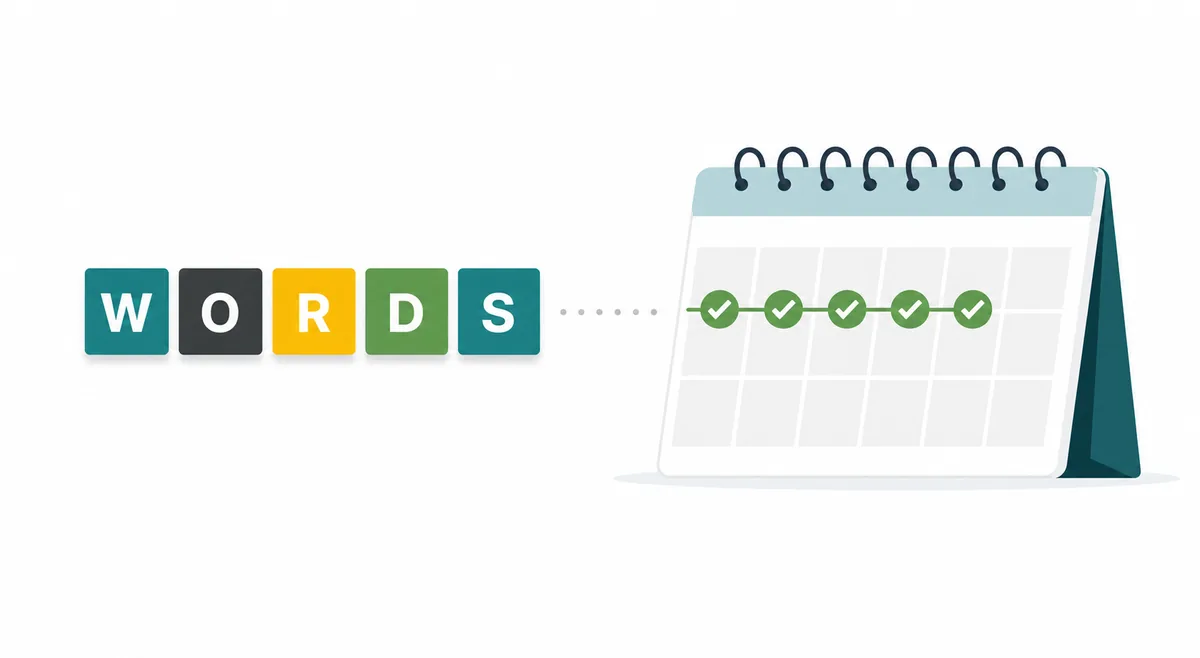
The short answer: a streak is a run of consecutive wins, but the exact rule depends on the game
A Wordle streak normally means the number of puzzles you have solved consecutively. The important detail is that there is no single universal implementation. Some daily games tie a streak to calendar dates, while practice modes may count every completed win. Before comparing your number with somebody else's, check whether both games count the same modes, losses, and missed days.
On Wordless.blog, the current streak and best streak are browser-side statistics. A win in a non-archive game increases the current streak by one and can raise the best streak. An unsolved non-archive game resets the current streak to zero. Archive puzzles are deliberately excluded because a past date can be replayed; counting replays as daily consistency would make the number misleading.
That makes the best Wordle streak advice practical rather than superstitious: protect the next decision, use the smallest useful hint when you are stuck, and use archive or infinite practice for learning instead of treating every practice round as a test of your daily record. The guide below separates general Wordle habits from the rules that apply specifically to Wordless statistics.
Wordle streak modes at a glance
The mode you choose changes what a result means. Use this table before assuming that a replay, practice win, or custom challenge should appear in the same streak.
| Situation | Effect on Wordless streak | Best use |
|---|---|---|
| Current daily puzzle | A win increases the local streak; a loss resets it | Keep one focused daily attempt |
| Wordle Archive puzzle | Excluded from daily streak and general statistics | Replay a missed or difficult date |
| Wordle Infinite practice | A completed win updates non-archive statistics | Practice repeatedly, then read the stats honestly |
| Custom Wordle challenge | A completed non-archive result uses the same local stats path | Share a challenge, but do not compare it with a daily record |
| Cleared browser storage | Local statistics can disappear because the browser data is removed | Keep the same browser profile if the number matters |
What counts as a Wordle streak?
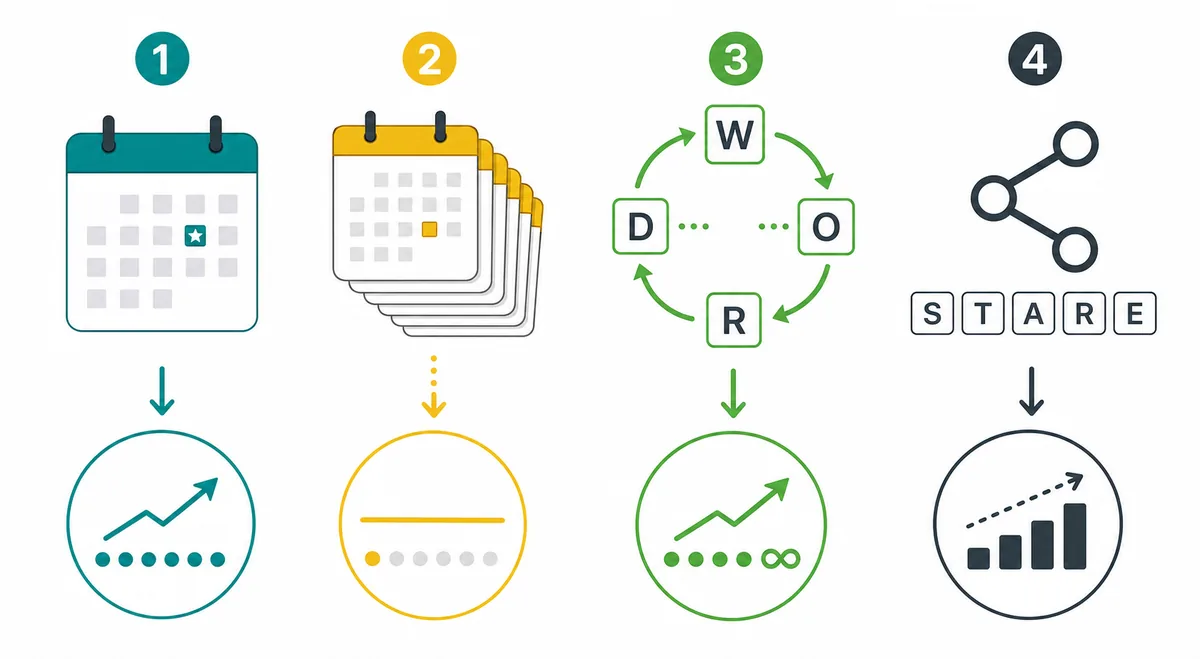
The simple definition is consecutive wins, but three questions make the definition useful: what is the unit being counted, what happens after a loss, and which modes are included? A daily streak usually represents one current puzzle per calendar day. A practice streak may instead represent consecutive wins in a session. Neither number is automatically more impressive; they answer different questions.
A current streak tells you how long the present run has lasted. A best streak records the largest run you have completed in the same statistics system. Win rate is different again: it divides wins by played games, so it can remain high even after a streak has ended. Average guesses measures speed or efficiency, not consistency. Keeping these metrics separate prevents a good average from being mistaken for a long streak.
If a search result asks for the longest Wordle streak, treat the phrase carefully. There is no reliable universal leaderboard covering every Wordle-style game, device, and mode. A private best streak is meaningful to the person who earned it, but it should not be presented as a verified world record unless a named competition publishes a method and a source.
- Current streak: the number of consecutive wins in the current run.
- Best streak: the largest consecutive-win run recorded by that statistics system.
- Win rate: the percentage of played games that were wins, whether or not they were consecutive.
- Average guesses: a performance measure that does not tell you whether the wins were consecutive.
Daily, archive, infinite, and custom modes do not mean the same thing
Daily play is the cleanest setting for a traditional Wordle streak because there is one current challenge and a clear reason to return tomorrow. The board gives you a limited decision window, so a routine matters: open the puzzle when you have enough attention, record the clues, and avoid making a rushed guess merely to preserve a number.
Archive play has a different job. It lets you choose an earlier date and replay a stable puzzle, which is useful after a missed day or a difficult board. Because the same date can be opened again, Wordless excludes archive results from daily streak statistics. This is not a missing feature; it is a boundary that keeps a replay from looking like a new daily win.
Infinite and custom play are practice-oriented. In the current Wordless implementation, a completed non-archive result goes through the local statistics update path, so a win can change the displayed streak even though the session is not a daily calendar challenge. Read the mode label and the statistics explanation together. If you want a pure daily record, keep practice separate in your own notes instead of treating every number as directly comparable.
What resets a Wordle streak?
The most direct reset is an unsolved puzzle. In Wordless, a completed non-archive loss sets the current streak to zero while the played count and other history remain useful. A reset does not erase your best streak; it only starts a new current run. That distinction matters when you review progress after a hard board.
A missed calendar day is more complicated than many quick guides suggest. A date-based product may consider an absent daily result a break, while a session-based product may not know that you skipped a day. Wordless stores the current streak as a local count and does not use a calendar-gap field in the game statistics update. Do not assume that a missed day alone has the same effect as a loss on this site.
Browser state is another edge case. The game saves basic statistics in local storage. Clearing site data, changing browser profiles, using private browsing, or moving to another device can make the displayed streak look new because the old local record is no longer available. That is a storage boundary, not evidence that your solving history was judged incorrectly.
- Loss: resets the current streak in the non-archive statistics path.
- Archive replay: does not update the daily streak.
- Cleared local storage: can remove the browser-side record entirely.
- Missed day: depends on the product's calendar rules; do not import assumptions from another Wordle app.

How to protect a Wordle streak without guessing blindly
The safest streak habit is to protect information before you protect the number. If you are tired or distracted, an extra minute spent reading the board is usually less risky than submitting a familiar-looking word. Start with the fixed letters, list the confirmed but misplaced letters, and remove the letters that the clues actually exclude. A clean constraint list prevents a panic guess from throwing away a solvable board.
Use the first guess to open the board and the next guess to answer a specific question. Early in the puzzle, test distinct common letters and useful vowels. In the middle, keep every green position and move each yellow letter only into a position that has not failed. Near the end, compare the remaining candidates and decide whether you need an information guess or a direct solution. The Wordle Strategy guide expands this routine with opening and second-guess examples.
When you need help, choose the smallest intervention that keeps the solve yours. The Wordle Hints guide is appropriate when you need a reminder or a gentle constraint. The Wordle Solver is more suitable when the board is already encoded as green, yellow, and gray rules. A streak is not improved by hiding the fact that you used a tool; it is improved by making the next decision more deliberate and understanding why it worked.
- Pause before a forced-looking guess and reread every row.
- Keep a separate list of fixed, movable, and excluded letters.
- Test one clear idea per guess instead of repeating a whole earlier word.
- Use hints or a solver to reduce uncertainty, not to publish an answer spoiler.
What to do after a streak reset
A reset is useful data if you can identify the cause. Was the board lost because a duplicate letter was missed, because a yellow letter was placed in a blocked position, or because the final guesses were rushed? Write down one concrete failure mode rather than labeling the whole game as bad. The next run only needs one adjustment, such as checking repeated letters before the fifth guess.
Use the archive for calm replay practice instead of immediately risking another current puzzle. Pick a past date, solve it without counting the result toward the daily run, and compare the opening and second guess. If the same pattern keeps causing trouble, read the Double Letters or Hard Mode guide. If you want repeated reps, Infinite mode can provide them, but remember that practice results use a different context from a daily record.
Rebuilding is also easier when the target is small. Aim for three careful wins, then five, instead of trying to match your old best streak on the first attempt. Track the process you can control: opening quality, clue transcription, candidate checking, and whether you stopped before a careless submission. A current streak is a moving count; the solving habits behind it are the durable achievement.
Wordless statistics, local storage, and honest comparisons
Wordless displays played games, win rate, current streak, best streak, and a guess distribution. These values are generated in the browser from the statistics object saved under the site's local storage key. The page does not need an account to calculate the display, and the Wordle Calculator can help you inspect aggregate wins, losses, average guesses, and distribution when you want a broader performance view.
Local storage is useful for a fast, account-free game, but it is not a cloud backup. The record belongs to the browser profile and device that hold it. Before clearing site data, changing profiles, or testing in a private window, assume that the local statistics may not follow you. The privacy policy explains the site's use of browser storage; this page does not promise recovery of data that the browser has removed.
For a fair comparison, keep the context next to the number: daily or practice, five letters or another length, current run or best run, and whether archive games were excluded. A screenshot with a high number can be motivating, but it is not enough to compare two people unless the counting method is known. The most useful Wordle streak is the one whose rules you can explain.
Wordle streak FAQ
What is a Wordle streak?
A Wordle streak is a run of consecutive wins. The exact counting rule varies by product. Wordless tracks a current streak and best streak in browser-side statistics, and a non-archive loss resets the current run.
What is the longest Wordle streak?
There is no universal verified longest streak across every Wordle-style game, device, and mode. Treat a longest-streak claim as meaningful only when its game, time period, and counting rules are documented.
What happened to my Wordle streak after I lost?
In Wordless, an unsolved non-archive game resets the current streak to zero but does not erase the best streak. Use the reset as a starting point for a new run and review the clue or decision that caused the loss.
If I missed Wordle yesterday, did I lose my streak?
That depends on the product. Calendar-based games may treat a missed daily puzzle as a break. Wordless stores a local streak count and does not use a calendar-gap field in its statistics update, so do not assume a missed day alone equals a loss here.
Do Wordle Archive puzzles change a streak?
Wordless Archive puzzles do not change the daily streak or general statistics. Archive dates can be replayed, so keeping them separate makes the daily number more honest.
How can I keep a Wordle win streak?
Read the board before guessing, keep green letters fixed, move yellow letters deliberately, check duplicate-letter evidence, and use a spoiler-free hint or solver when you need focused help. Practice in Archive or Infinite mode when you want repetition.
Is my Wordle streak saved online?
Wordless saves basic game statistics in your browser's local storage rather than requiring an account. Clearing site data, switching profiles, or using another device can remove or separate the displayed record.