The most useful Wordle hints explain your next move, not the answer
Good Wordle hints are small pieces of information. Start with the board you already have: keep green letters in place, move yellow letters to positions you have not tested, and remove gray letters unless duplicate-letter evidence changes the rule. Then choose a guess with one clear job. That might be testing three new consonants, checking a likely word ending, or separating two candidates that look almost identical.
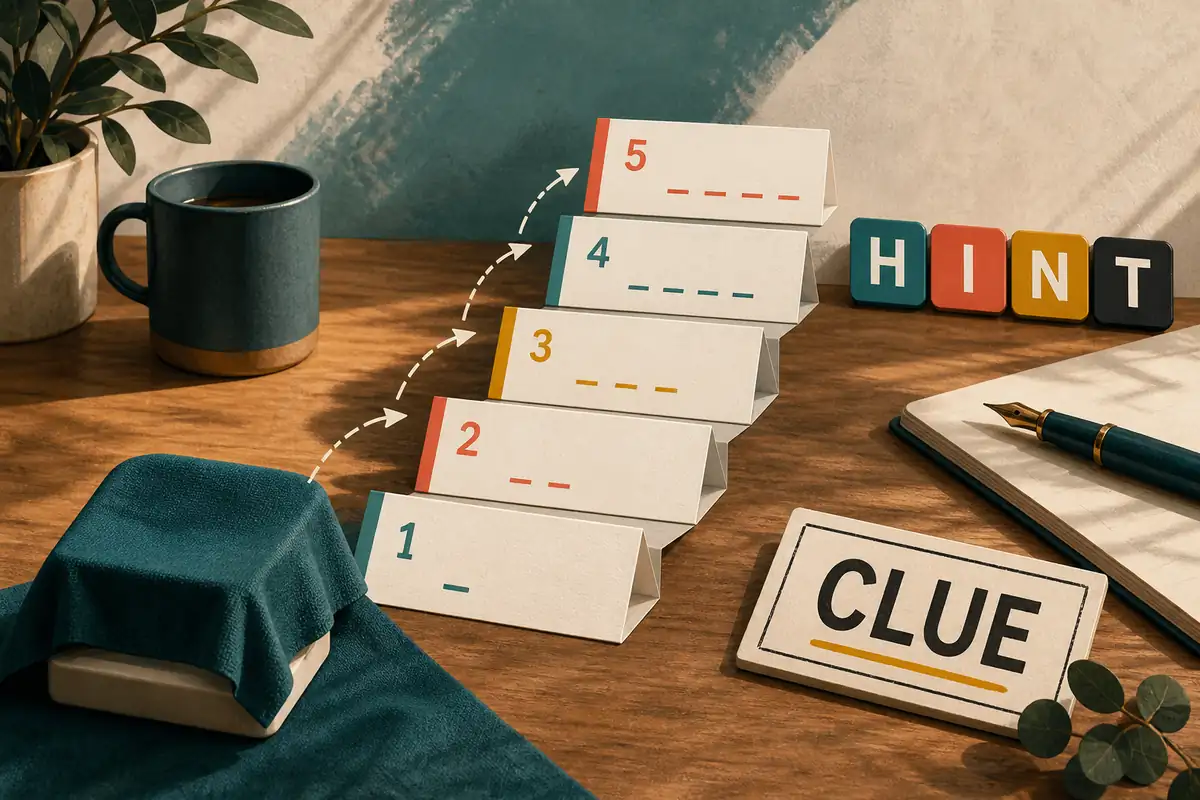
A spoiler-free hint ladder is more useful than a single answer because it preserves the solving process. First ask what kind of clue you need. A broad hint can remind you to test a vowel or a common consonant. A narrower hint can reveal a word pattern, position, or letter count. Only the final layer should approach the answer, and even that layer can remain optional.
This guide is about reusable Wordle hints for Wordless and other Wordle-style boards, not a daily answer feed. For a current candidate list, use the Wordle Solver after you have tried the clues yourself. For a complete opening and mid-game routine, read the Wordle Strategy guide.
A Wordle hint ladder compared by how much it reveals
Use the least revealing hint that lets you make a better next guess. The goal is to turn uncertainty into a constraint without skipping the reasoning that makes the game satisfying.
| Hint level | What it reveals | Best use | Spoiler risk |
|---|---|---|---|
| Level 1: process | Which clue type to inspect next | You have a messy board and no plan | Very low |
| Level 2: letters | A vowel, consonant, or letter group worth testing | Your first guess gave little information | Low |
| Level 3: position | A fixed slot or a yellow letter that must move | You have a partial pattern | Medium |
| Level 4: shape | A pattern such as _A__E or a likely ending | Only a short candidate family remains | Medium-high |
| Level 5: answer | A direct solution or nearly complete word | You are reviewing a finished puzzle | High |
1. Start with a hint ladder instead of searching for the answer
When players search for Wordle hints, they often mean different things. One player wants to understand a yellow tile. Another wants a nudge toward a vowel. A third wants the exact answer for today. Those are different levels of help, so decide which level you need before you read anything else. If you only need a process reminder, do not expose yourself to a full answer page.
At Level 1, describe the board in plain language: fixed letters, movable letters, banned letters, and the number of rows left. At Level 2, choose one information goal, such as testing O and U or checking common consonants. At Level 3, use a position hint only after the letter set is clearer. At Level 4, compare word shapes. Keep the answer layer for post-game review or a puzzle you have consciously decided to abandon.
This order matters because a hint should improve your next decision. A clue that makes you skip three reasoning steps may solve one board but teach you nothing for the next one. A small hint that you can apply yourself is usually more valuable than a dramatic reveal.
- Need a plan? Use a process hint.
- Need information? Test a useful letter group.
- Need confirmation? Compare the remaining word shapes before revealing an answer.
2. Turn green, yellow, and gray clues into rules
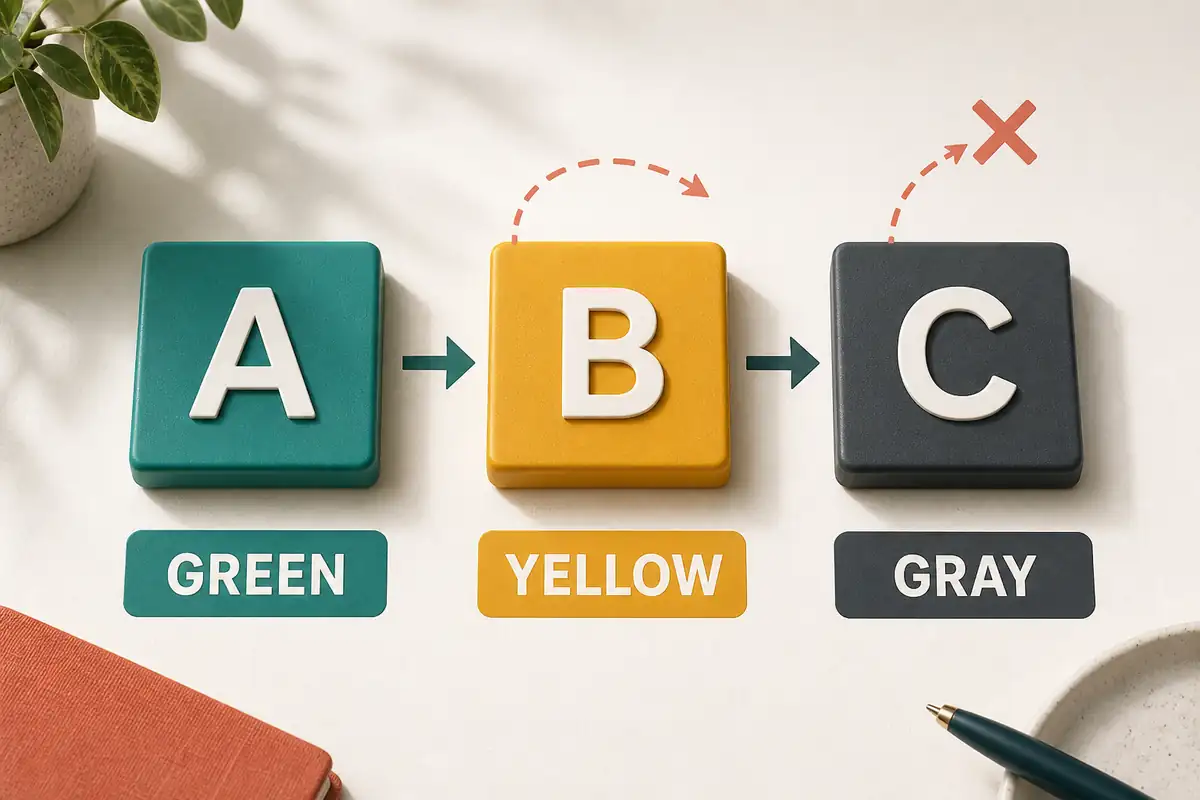
The fastest way to use Wordle clues is to translate colors into constraints. Green means the letter is correct and in the correct position. Yellow means the letter belongs in the answer but not in the position where you played it. Gray usually means the letter is absent, but duplicate letters can make a gray copy more subtle. These are not decorative colors; they are three different kinds of evidence.
Write the evidence in a compact sentence after every row. For example: E is green at the end, A is yellow and cannot stay in slot two, and S, T, and R are gray. The sentence is easier to act on than a quick glance at the board because it tells you what your next guess must respect. If the game has a longer 6-8 letter mode, use the same rule but mark chunks and endings as well as individual slots.
A common mistake is treating a yellow letter as a letter that should simply move one space to the right. That can leave it in another tested position or create a word that violates a green clue. Move it deliberately and use the next guess to test a new position plus at least one new piece of information.
- Green: lock the letter in that slot.
- Yellow: keep the letter and change its slot.
- Gray: remove the letter unless duplicate evidence says there may be another copy.
3. Make the next guess answer one question
The best next guess is not always the word that feels closest to the answer. It is the word that gives you the most useful information while respecting the clues. If your opening row is mostly gray, test several common letters that you have not used. If you already have two greens and a yellow, build a realistic pattern instead of throwing away the evidence for another broad opener.
Suppose SLATE returns a green E at the end, a yellow A, and gray S, L, and T. Your next question might be: where can A move while I test fresh consonants? A guess that repeats S, L, and T does not answer that question. A guess that moves A, keeps E, and tests new letters does. You are not trying to guess faster; you are making the remaining possibilities easier to compare.
When several answers share a shape, a separator word can be useful outside strict hard mode. If BOUND, FOUND, HOUND, and SOUND are all plausible, a word that tests B, F, H, and S can separate the family before you commit. In hard mode, you may have to choose a legal candidate instead, so preserve flexibility earlier in the board.
- Few clues: maximize new-letter coverage.
- Several clues: build a pattern that obeys them.
- Several candidates: test the letters that separate them.
4. Treat repeated letters as a later hint, not an early guess
Repeated letters are one of the main reasons a Wordle board can feel misleading. A word can contain two copies of a letter even when your guess makes one copy green, another yellow, or one copy gray. The colors are counted against the answer's available copies, so a mixed result can tell you that the answer contains fewer copies than your guess.
Early in a puzzle, a repeated-letter guess often tests fewer unique letters. That is why words such as EERIE or MAMMA can be expensive openers even though they are valid words. Once your board has a strong pattern or normal candidates stop fitting, the repeat-letter possibility becomes a useful hint. At that point, test a duplicate because the evidence earned it, not because you are out of ideas.
If you want a detailed explanation of one yellow and one gray copy, use the Wordle Double Letters guide linked below. Keep the distinction between a rule question and a hint question clear: this page tells you when duplicate-letter logic is useful, while the dedicated guide explains the counting behavior in depth.
- Do not spend the first row on duplicates without a reason.
- A yellow plus gray copy can indicate that only one copy is present.
- Use repeat-letter hints when the remaining pattern supports them.
5. Adjust Wordle hints for hard mode and practice boards
Hard mode changes what counts as a useful hint because known green and yellow letters must be reused. You cannot always play a free separator word that ignores the current clues. The best hint is often a reminder to keep a legal word family open: do not lock yourself into one narrow ending if the board still has several possible consonants.
Practice changes the purpose of a hint. In Wordle Infinite, try the same hint ladder across several boards and notice which opening guesses give you a clear second move. Wordle Unlimited is useful when you want a no-wait rhythm. Custom Wordle is useful when you are teaching someone why a color is meaningful. The mode changes, but the process remains: collect evidence, state the constraint, choose a job for the next row.
For 3-8 letter Wordless boards, scale the hint rather than replacing it. Short words make each slot more important. Five-letter boards reward common-letter coverage. Longer words reward endings, prefixes, and chunks such as ING, TION, ER, and LY. A good hint describes the board size and the pattern you actually have; it does not force a five-letter assumption onto every mode.
- Hard mode: prefer hints that preserve legal clue constraints.
- Infinite mode: use repeated boards to test whether your process works.
- Longer words: look for chunks as well as individual letters.
6. Follow a spoiler-free Wordle hint example
Start with CRANE. Imagine C and R are gray, A is yellow, N is gray, and E is green at the end. Your board now says: the answer ends in E, contains A somewhere other than slot three, and probably does not contain C, R, or N. The first useful hint is not a word. It is the rule set you just wrote.
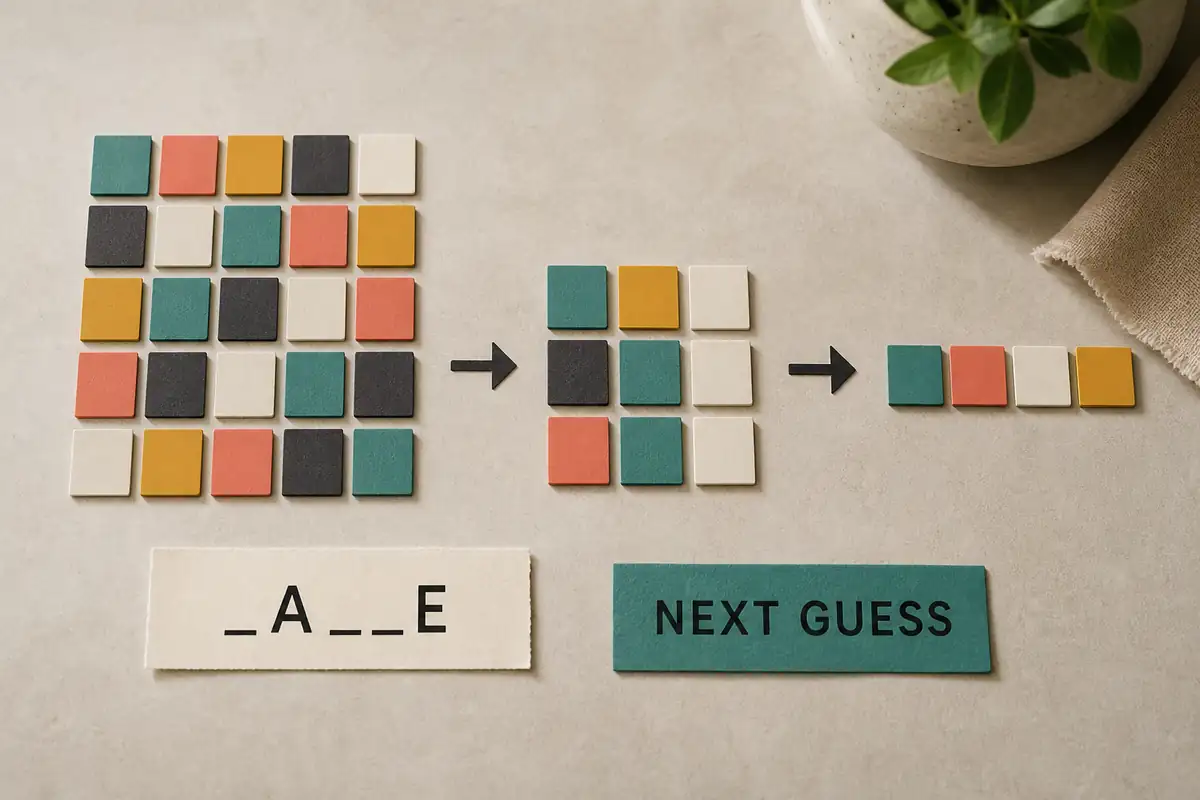
For the second guess, move A and test fresh consonants while keeping E fixed. Imagine that guess creates a green A in slot two and a yellow T. The pattern is now _A__E, T must move, and C, R, and N remain excluded. You have narrowed the board without needing a direct answer. If only a few candidates remain, compare their differing letters and choose between solving and separating.
This example is intentionally not tied to today's official Wordle answer. Current answer pages have a different freshness and spoiler intent. An evergreen Wordle hints guide should teach a repeatable method that still works tomorrow, in Wordless Infinite, and on a longer practice board.
- State the fixed, movable, and banned letters.
- Let the next guess test one clear question.
- Stop exploring when one candidate explains every clue.
7. Use a Wordle solver as a review tool when you need it
A solver is helpful when the board has become a constraint problem that is hard to search mentally. Enter the known green positions, yellow letters, and excluded letters, then compare the candidates with your own reasoning. The strongest use of a solver is review: see which words fit, ask why they fit, and notice which clue you forgot to apply.
Do not confuse a solver with a hint ladder. A solver may return a long candidate list or a high-information next guess, while a hint can preserve the challenge by revealing only the next constraint. Use the least help that solves your actual problem. If you forgot how colors work, read the rules. If you need to filter a pattern, use the solver. If you want to improve your overall routine, read the strategy guide.
Wordless is independent from The New York Times Wordle. The page links below point to the official game only for terminology and reference. They do not imply that Wordless shares the official answer list, daily schedule, or product affiliation.
- Try your own clue translation before opening a candidate filter.
- Use a solver to audit reasoning, not to claim an official answer.
- Choose a strategy or rules guide when the problem is broader than one board.
FAQ about Wordle hints
How can I get Wordle hints without spoilers?
Use a hint ladder. Start with a process reminder, then a letter or position clue, then a word pattern only if you still need help. Avoid daily answer pages until you have decided that a direct reveal is acceptable.
What do the green, yellow, and gray Wordle hints mean?
Green means the letter is correct and in the correct slot. Yellow means the letter is in the answer but must move. Gray usually means the letter is absent, although duplicate letters can make one gray copy more subtle.
Are Wordle clues and Wordle hints the same thing?
They overlap, but clues are the evidence produced by your guesses, while hints are extra guidance about how to interpret or act on that evidence. This guide uses both terms for the same spoiler-free solving process.
Should I use Wordle hints today pages for Wordless?
A today page usually targets a date-specific puzzle and may reveal an answer that does not belong to Wordless. Use this evergreen guide for clue logic, then play Wordless or use its solver for the board in front of you.
When should I use a Wordle solver instead of a hint?
Use a hint when you want to keep solving and only need one more constraint. Use a solver when you need to filter known letters, audit a finished board, or compare a candidate list after trying the clues yourself.
Can Wordle answers have repeated letters?
Yes. Repeated letters can change how one yellow and one gray copy should be read. Treat duplicate-letter guesses as a deliberate test after the board gives you evidence, and use the dedicated double-letters guide for the full rule.