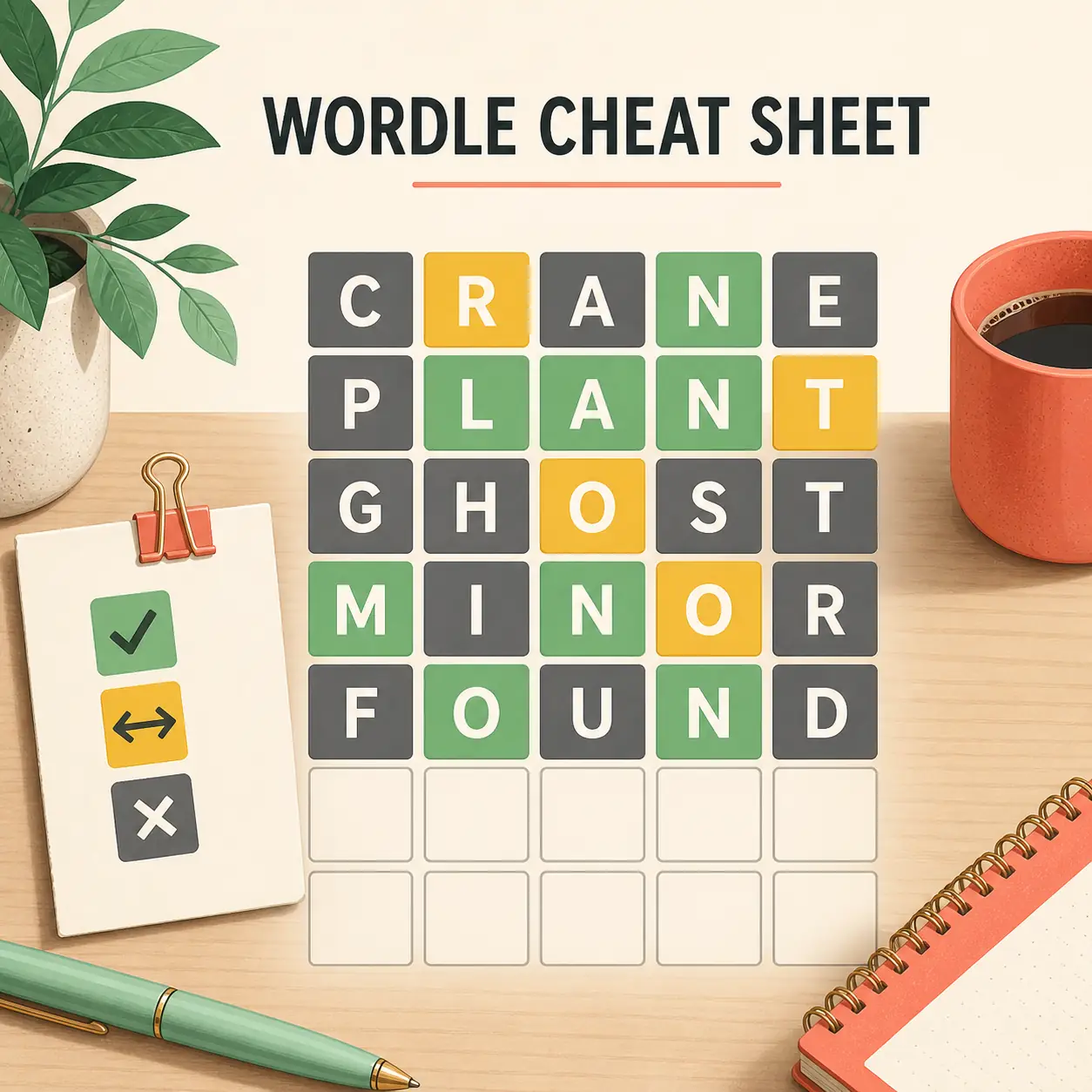
The short version: use the cheat sheet to make one better decision
A useful Wordle cheat sheet is not a list of today's answers. It is a compact reminder of what each color means, which information your next guess should test, and when a repeated letter deserves attention. Start by writing the board as three lists: fixed letters, movable letters, and excluded letters. Then choose one question for the next row instead of trying to solve every possibility at once.
Green letters stay in their positions. Yellow letters belong in the answer but must move to a position you have not tested. Gray letters are normally excluded, although duplicate-letter scoring can make one gray copy less simple. Once those rules are clear, use a balanced opener early, a clue-respecting pattern in the middle, and a candidate comparison near the end.
This page is an evergreen, spoiler-free reference for Wordless and similar word puzzles. It does not publish a current official answer, claim an affiliation with The New York Times, or encourage scripts that inspect a hidden word bank. If you need more detail, move to the Wordle Hints, Wordle Strategy, Wordle Solver, or Double Letters page that matches the problem in front of you.
Wordle cheat sheet at a glance
Use the row that matches your board state. A quick reference works best when it tells you what to do next and when to stop using that particular idea.
| Board state | Your next job | Useful check | Avoid |
|---|---|---|---|
| Almost no clues | Test new common letters | Use a word with varied vowels and consonants | Repeating the same gray letters |
| One or two greens | Build a legal pattern | Keep the greens fixed while testing fresh letters | Throwing away useful positions |
| Several yellows | Move each letter deliberately | Track positions that are already ruled out | Moving a yellow into another tested slot |
| Several candidates | Separate before solving | Compare the letters that differ between candidates | Guessing the first familiar word |
| A possible double | Count copies carefully | Check yellow plus gray results together | Treating every gray copy as absolute |
| No progress | Choose the smallest help | Use a hint, word list, or solver for a reason | Jumping straight to a daily answer |
1. Scan the board before you search for a word
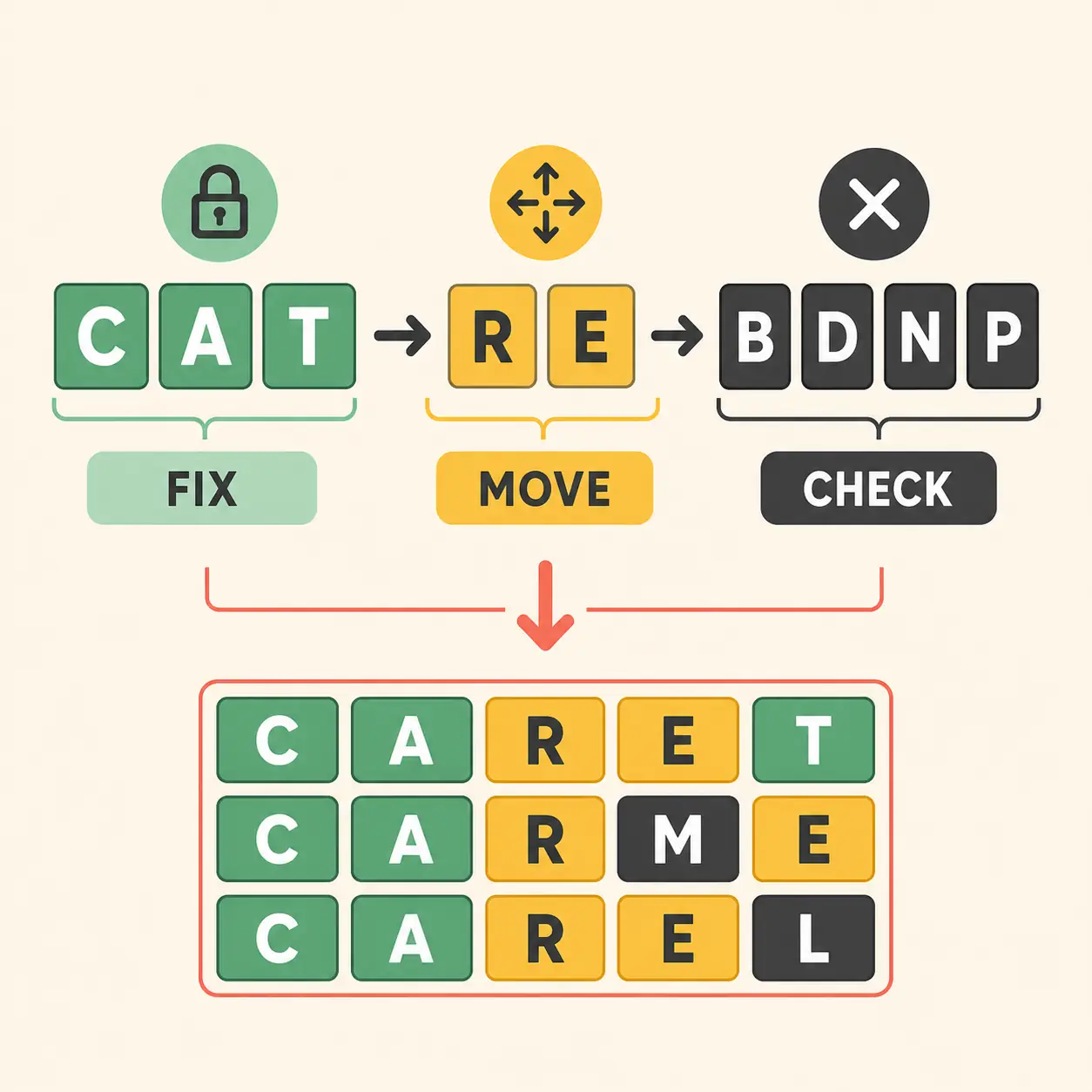
When a row feels confusing, do not begin by guessing another word at random. Read the board from left to right and convert it into a short rule set. Mark every green letter and position, write every yellow letter in a separate list, and record the positions where each yellow letter has already failed. Keep gray letters in a third list, but leave room for a duplicate-letter exception when the same guess contained more than one copy.
The scan should also include the number of rows left and the word length. Wordless supports 3-8 letter boards, so a five-letter habit can mislead you on a longer puzzle. For a six-letter board, endings and chunks may carry more information than one isolated vowel. For a short board, each position is more valuable and a broad opener may need to become a direct pattern sooner.
A good cheat sheet reduces mental load without removing the puzzle. If you can say the board in one sentence, you are ready for the next guess. For example: E is green at the end, A is yellow but not in slot three, and S, L, and T are gray. That sentence is more actionable than staring at six colored rows.
- Fixed: letters that must stay in the same slot.
- Movable: letters that belong in the answer but need a new slot.
- Excluded: letters that should be avoided unless duplicate evidence changes the rule.
2. Read green, yellow, and gray as three different rules
Green is both a letter clue and a position clue. Keep it exactly where it is unless you are correcting an input mistake. Yellow confirms that the letter exists somewhere in the answer, but it does not tell you which untested position is correct. Gray usually removes a letter from the candidate set, but the result must be read alongside any other copy of that letter in the same guess.
The most common mistake is treating yellow as a letter that can move one space to the right. That can put it in another position you have already tested. Instead, keep a tiny position ledger: A is present, slots two and three are blocked, so the next guess must place A in one of the remaining slots. The ledger turns a vague hint into a constraint you can verify.
If you want the full color logic, use the site's How to Play page. If you want a spoiler-free nudge, the Wordle Hints page offers a ladder from process help to position and shape help. This cheat sheet keeps only the part needed for a quick decision, so it should link you onward rather than repeat every edge case.
- Green: keep the letter in that exact position.
- Yellow: keep the letter, but test a position that has not failed.
- Gray: remove the letter unless repeated-letter scoring gives a reason to keep one copy.
3. Give the first and second guesses different jobs
The first guess should create options. A word with several distinct, common letters can tell you which part of the alphabet and which vowel pattern deserves attention. There is no single magic opener for every board or every word length. CRANE, SLATE, RAISE, STARE, and TRACE are reasonable five-letter examples, but a useful opener is the one that leaves you with a clear second move rather than the one that looks best in isolation.
The second guess should respond to the evidence. If the opening row is mostly gray, test new high-frequency letters. If it produces two greens and a yellow, respect the pattern and move the yellow deliberately. If several answers share the same shape, a separator word can test the letters that distinguish them in normal mode. In hard mode, choose a legal candidate and preserve flexibility earlier in the game.
Do not confuse an information guess with a solution guess. An information guess may be unlikely to win the row but can remove several candidate branches. A solution guess follows the strongest pattern and tries to finish. The right choice depends on how many candidates remain and how many rows are available, not on a fixed rule that says every guess must be a likely answer.
- Early board: maximize useful new letters.
- Middle board: obey clues while testing one clear idea.
- Late board: compare candidates and solve when one word explains the evidence.
4. Check repeated letters only when the board earns the test
Repeated letters make a Wordle board feel inconsistent because colors are counted against the number of copies available in the answer. One copy may be green, a second may be yellow, and an extra copy may be gray. That gray tile does not always mean the letter is absent; it can mean the guess used more copies than the answer contains.
Early repeated-letter guesses are usually expensive because they test fewer unique letters. A word such as EERIE or MAMMA can be valid, but it gives less broad coverage than a word with five different letters. Later, when a pattern strongly suggests a duplicate or when ordinary candidates no longer fit, testing a repeat can be the most informative move.
The practical rule is to count copies before you ban a letter. If one A is yellow and another A is gray, keep one A in the candidate rule but do not assume two As are available. The dedicated Wordle Double Letters guide explains these mixed results in more detail; this cheat sheet only tells you when to stop treating the gray tile as a simple ban.
- Do not use a double as the opener without a reason.
- Read yellow and gray copies together, not as separate absolute rules.
- Test a repeat when the remaining pattern supports it.
5. When you are stuck, choose the smallest useful help
Getting stuck does not mean you need the answer. First decide whether the problem is a rule problem, a pattern problem, or a candidate-search problem. If you cannot remember what a color means, use the rules guide. If you know the colors but need a nudge, use a spoiler-free hint ladder. If you know the constraints and want to filter words, use the Wordle Solver or five-letter word finder.
A word list is useful for checking the boundary between accepted guesses and selected answers, but it is not automatically a solution. An archive is for past Wordless boards, not for a current official answer. A solver can show candidates, but you still need to verify that every green, yellow, gray, and duplicate-letter rule was entered correctly.
Choosing the smallest help protects the learning loop. A hint that reveals one position can teach you how to read the next board. A full answer may finish this board but gives no practice for tomorrow. This is why the quick reference uses the phrase spoiler-free: the page is designed to reduce uncertainty one decision at a time.
- Rule problem: read How to Play.
- Nudge problem: read Wordle Hints.
- Candidate problem: use Wordle Solver or a word finder after checking the clues.
6. Worked example: turn a messy row into a next move
Imagine that CRANE returns gray C and R, yellow A, gray N, and green E at the end. The board rule is now: the answer ends in E, A is present but not in slot three, and C, R, and N are excluded unless a duplicate explanation becomes necessary. The next guess should not reuse all three gray consonants just because they appeared in the first word.
Your second guess has one clear job: move A to a new position while testing fresh consonants and keeping E at the end. Suppose that guess makes A green in slot two and T yellow. You now have a pattern like _A__E, T must move, and C, R, and N remain blocked. The cheat sheet has done its job: it has not supplied a word, but it has made the candidate space smaller and more legible.
At this point, compare the remaining word shapes instead of submitting the first familiar word. If the candidates differ in one consonant, a separator may help in normal mode; if one candidate fits every clue and the rows are running out, solve. The quality of the move comes from the reason behind it, not from whether the guess looks clever.
- State the fixed, movable, and excluded letters.
- Make the next guess answer one question.
- Switch from exploring to solving when the evidence is sufficient.
7. Keep the cheat sheet spoiler-free and honest
The word cheat can mean different things in search results. Some people mean a compact reference; others want a current answer, a candidate finder, or instructions for inspecting a hidden script. This page uses cheat sheet in the first sense. It teaches a repeatable process and does not claim to reveal the official answer for today or to reproduce a private answer bank.
Wordless is an independent word puzzle site. The New York Times links in the reference section are included for terminology and public game context, not to imply affiliation, endorsement, or shared answer schedules. Wordless also supports practice modes and 3-8 letter boards, so the best next step may differ from a five-letter daily puzzle.
A good reference page should also admit its limits. Letter frequency is a useful starting heuristic, not a guarantee. Similar-looking candidates can require a deliberate separator. A word appearing in a dictionary does not prove that one game accepts it. When the page cannot answer your exact question, follow the related link to the focused resource instead of forcing one cheat sheet to do every job.
- Quick reference is not the same as a daily answer page.
- A dictionary word is not automatically a valid game guess.
- Use focused tools and guides when the board needs more detail.
FAQ about the Wordle cheat sheet
Is a Wordle cheat sheet the same as a Wordle answer page?
No. A cheat sheet is a quick reference for color rules, guess selection, and common mistakes. An answer page reveals a date-specific solution. This page intentionally stays evergreen and does not publish today's answer.
Is using a Wordle cheat sheet cheating?
It depends on what you want from the game. Using a reminder of the rules or a spoiler-free decision process can support learning. Copying a hidden answer or inspecting a private word bank skips the solving process. Choose the smallest help that solves your actual problem.
What are the best Wordle tips when I have no useful clues?
Use a balanced word with distinct common letters, then make the second guess test new information. Do not repeat several gray letters just because the first word felt natural. The best next word depends on your word length and the clues already on the board.
When should I use Wordle hints instead of a solver?
Use a hint when you want to keep solving and only need one more constraint or reminder. Use a solver when you have entered the green, yellow, gray, and repeated-letter rules and need to filter or compare candidates.
Can Wordle answers contain double letters?
Yes. A repeated letter can produce a green, yellow, and gray combination because the game counts copies against the answer. Read duplicate tiles together and use the dedicated double-letters guide when the result is unclear.
Does this Wordle cheat sheet work for Wordless 6-letter and longer modes?
The process works across Wordless 3-8 letter modes: record fixed, movable, and excluded letters, then look for chunks and endings as the word gets longer. The examples on this page use five-letter words because they are easy to read, not because the method is limited to five letters.