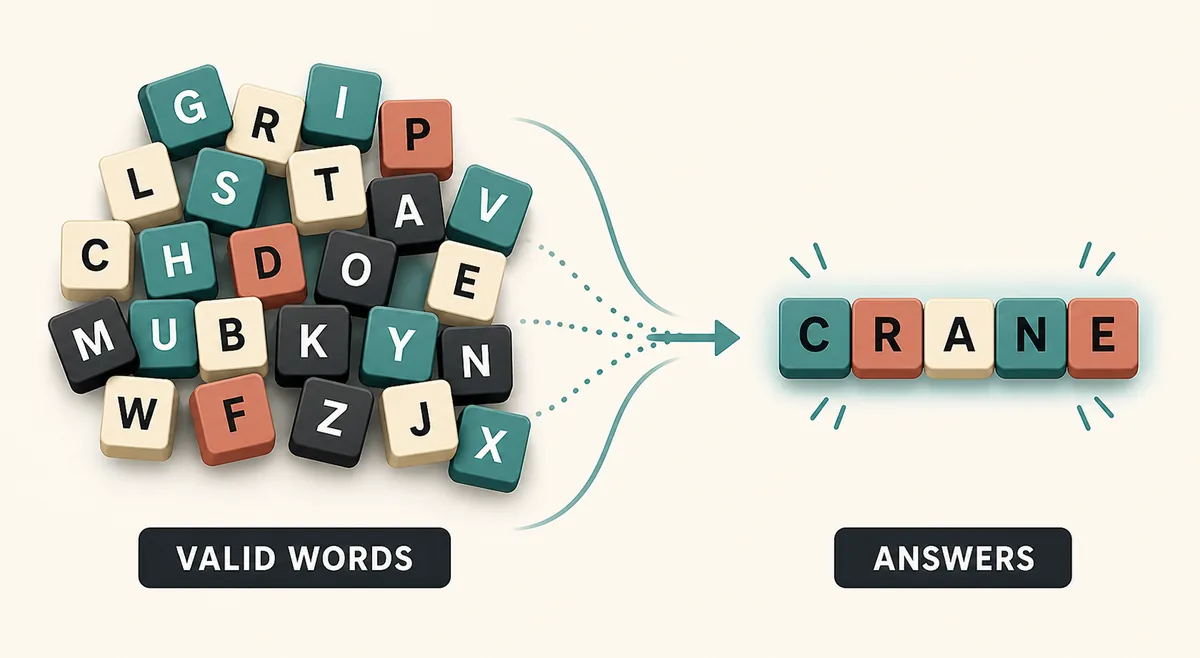
The short answer: a Wordle word list is not the same as an answer list
A Wordle word list normally refers to the words a game accepts as guesses. That set can be much larger than the words chosen as solutions. An answer list is a historical or current record of selected solutions, while a valid-guess list is a working vocabulary used to test letters, patterns, and clue constraints. Treating them as identical creates confusion when a word is accepted but never appears as the answer.
Use the broad list when you need to understand whether a candidate is a real playable word or when you want to compare possible patterns. Use a dated answer list when you are checking a past puzzle or avoiding a repeated solution. Use a solver or five-letter word finder when you already have green, yellow, and gray information and need a smaller candidate set.
This guide is about the boundary between those resources. It does not publish today's official answer, promise that every dictionary word is accepted, or present Wordless as affiliated with The New York Times. The practical goal is simple: use word lists to reason better, then let the clues decide which candidate deserves the next row.
Wordle word list: which set are you looking at?
Use this table before you search for another list. The same word can be useful for a guess, appear in a historical archive, or belong to a dictionary without being an eligible answer in one particular game.
| Set | What it contains | Best use | What it does not prove |
|---|---|---|---|
| Valid guess list | Words the game can accept as an input. | Test new letters or build a legal pattern. | It does not mean every word can be selected as an answer. |
| Answer list | Selected solutions from a known date or puzzle sequence. | Check a past puzzle or study repeated answers. | It is not the full pool of playable guesses. |
| Dictionary | A language reference with definitions and variants. | Check spelling or meaning outside the game. | The game may reject words the dictionary contains. |
| Word finder | A filter that returns words matching letter rules. | Search starts, endings, included letters, and patterns. | A matching word still needs to fit every clue. |
| Solver | A clue-aware candidate filter and next-guess helper. | Combine green, yellow, and gray evidence. | It does not turn an uncertain list into an official answer. |
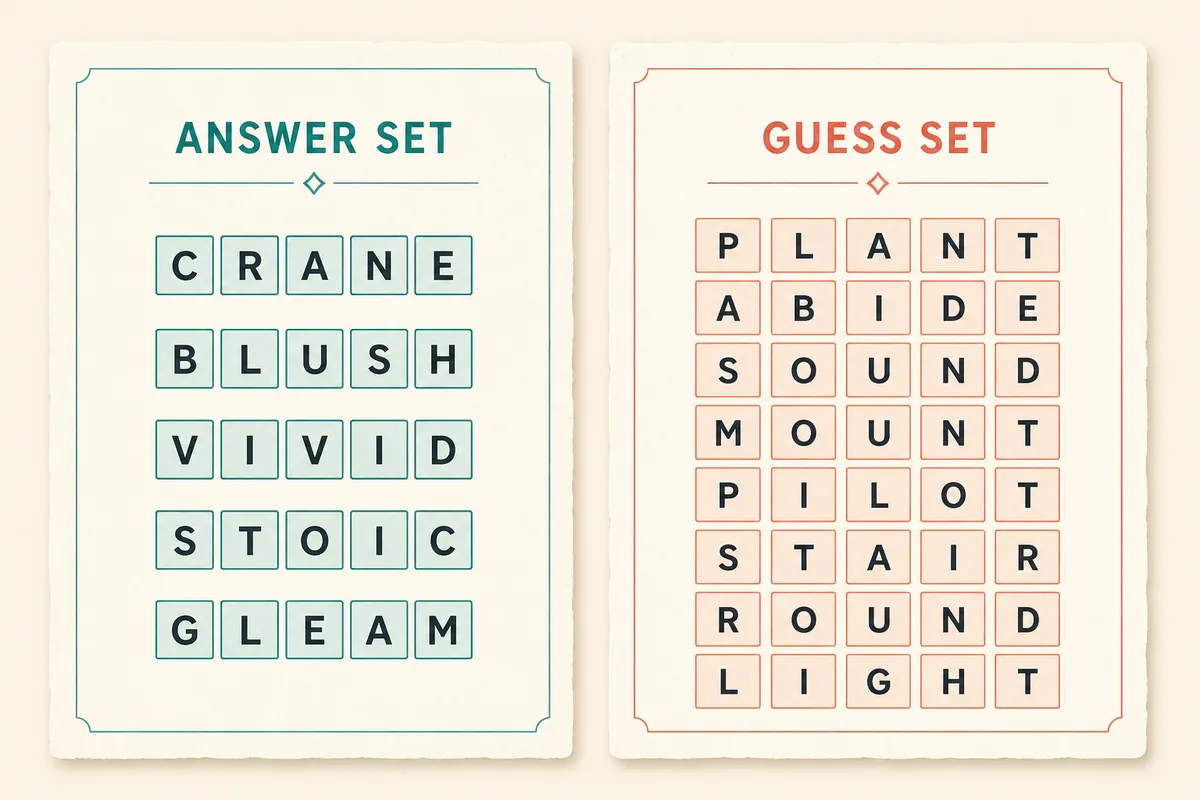
1. Answer words and valid guesses are not the same list
The most important distinction is selection versus acceptance. A game needs a list of possible answers so it can choose a hidden word, but it also needs a larger list of legal guesses so players can probe the board. The larger list lets you play a useful word that tests several new consonants even when that word was never intended to be the solution.
This is why a player can enter a perfectly ordinary word and receive color feedback without ever seeing that word in an answer archive. The word did its job as an experiment. It exposed a green position, confirmed a yellow letter, or removed several gray letters. A word list that mixes every accepted guess with every selected answer hides that difference.
For Wordless-style boards, the boundary can also change with word length and the site's own word data. A five-letter list should not be assumed to describe every 3-8 letter board. Look for the page or tool's stated scope, and treat a list as evidence for candidate building rather than as proof of the hidden word.
- Answer words are selected solutions; valid guesses are inputs the game accepts.
- A useful guess can be absent from a historical answer list.
- Word length and the specific game's word data can change the accepted set.
2. What a useful Wordle word list should contain
A useful list should tell you what its rows represent. At minimum, the page should distinguish current or historical answers, valid guesses, rejected words, and words that are present only because a broader dictionary was used. Without that label, a long alphabetical list looks complete while leaving the key question unanswered: can the game actually accept this word?
The best lists also preserve the original spelling and do not silently merge singulars, plurals, proper nouns, abbreviations, or variant forms. Word games often use a curated vocabulary rather than an unrestricted dictionary. That curation may explain why a familiar word is rejected or why an uncommon word is accepted.
For practical solving, the list becomes more useful when it can be grouped by word length, first letter, ending, repeated-letter shape, or known pattern. You do not need every category on one page. You do need enough context to avoid treating a sorted data dump as a complete solving method.
- Label the difference between selected answers and accepted guesses.
- State the word length and game scope instead of implying universal coverage.
- Keep spelling, duplicates, and unusual entries visible rather than silently rewriting them.
3. How to use a word list after green, yellow, and gray clues
Start by turning the board into rules. Green letters stay in their exact positions. Yellow letters must remain in the word but move to another position. Gray letters are normally removed, with an important exception for duplicate-letter counting. Once those rules are written down, a broad list becomes a candidate source instead of a source of random guesses.
Next, decide what the next row needs to do. If the first guess produced almost no information, choose a valid word with fresh common letters. If the board already shows a pattern such as _A__E, search the list for words that fit the fixed slots and test the remaining uncertain letters. If only a few candidates remain, compare their differing letters before spending another row.
Do not search the whole list by eye when a clue filter can do the repetitive work. A five-letter word finder is useful for simple starts-with, ends-with, contains, excluded-letter, and pattern conditions. The Wordle Solver is a better fit when the board contains several green and yellow constraints. The list explains the vocabulary; the tool applies the constraints.
- Write fixed, movable, and excluded letters before opening a candidate list.
- Use a fresh-letter guess when the board is broad and a pattern match when it is narrow.
- Switch from exploration to solving when one candidate explains every clue.
4. Repeated letters can make a word list look contradictory
Duplicate letters are a common reason players think a word list or clue checker is wrong. Suppose a guess contains two copies of a letter but the hidden answer contains only one. One copy may receive a useful color while the second copy is gray. That gray tile does not necessarily mean the letter is absent; it can mean the answer has no additional copy left after the matched occurrence is counted.
When you filter a list, keep the count of each letter in mind. A pattern with one confirmed A is not the same as a pattern that permits two As. A candidate that matches the visible positions can still fail because it contains too many copies of a letter that the board has already limited.
Repeated-letter logic is a reason to delay aggressive filtering, not a reason to trust a random duplicate guess. Read the exact colors first, then compare candidates with the same shape. The dedicated Wordle Double Letters guide goes deeper into mixed yellow and gray results, while this page keeps the focus on how the list should be interpreted.
- A gray duplicate can limit the count of a letter rather than remove every copy.
- Check both positions and letter counts before rejecting a candidate.
- Use repeated-letter tests when the clues give you a reason.
6. Worked example: from clues to a short candidate list
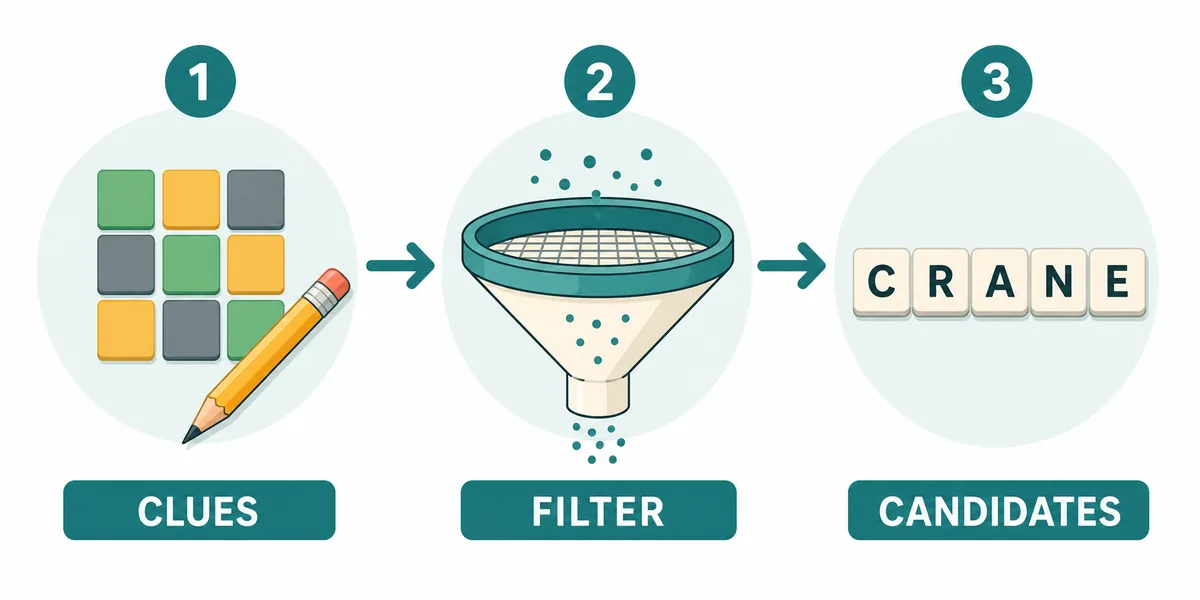
Imagine the first guess is CRANE. C and R are gray, A is yellow, N is gray, and E is green in the final position. Before searching, write the rules: the answer ends in E, includes A somewhere other than slot three, and probably excludes C, R, and N. The useful output of the first row is not a single answer; it is a smaller description of the answer space.
For the second row, choose a valid word that keeps E fixed, moves A, and tests fresh consonants. If that row makes A green in slot two and T yellow, the pattern becomes _A__E with T somewhere other than its tested slot. At this point, a filtered word list can show candidate shapes, but you should still compare each candidate against every gray, yellow, and duplicate-letter rule.
The final choice should explain the whole board, not merely resemble one clue. If several candidates remain, use a separator word only when the mode allows it and when the information is worth the row. In hard mode, keep known clues in the guess. This workflow prevents the common mistake of copying a word from a list without checking whether it is legal for the current board.
- Translate colors into a written constraint before searching.
- Ask the next guess to test one clear uncertainty.
- Verify every candidate against the full clue set, not one attractive pattern.
7. Limits, freshness, and spoiler-safe word lists
No public list should be described as universal unless its source and game scope are clear. Word lists can change when a game updates its dictionary, adds a word length, changes its answer pool, or corrects an entry. A list copied from another game may also contain words that the current board rejects. Check the page's update date and stated source before treating it as current.
A spoiler-safe guide should also separate evergreen vocabulary from date-specific answers. Publishing a full current answer near a query about word lists can satisfy a different intent while ruining the reader's puzzle. This page keeps examples generic and sends date-specific checking to the answer archive, which is a clearer and more respectful boundary.
Finally, remember that a list is a reasoning aid, not a guarantee of success. The strongest workflow combines a clearly scoped list, accurate color interpretation, a pattern filter, and a decision about when to stop exploring. That combination remains useful for Wordless practice boards as well as other Wordle-style games, even when their exact word data differs.
- Check scope, word length, source, and update date before trusting a list.
- Keep current answers separate from evergreen solving guidance.
- Use the list to reduce uncertainty, not to claim an official answer.
FAQ about Wordle word lists
Is a Wordle word list the same as a list of answers?
No. A valid-guess list can include words the game accepts for testing clues, while an answer list records words selected as solutions for particular dates or puzzles. The answer set is usually narrower than the guess set.
Where can I find a list of common five-letter words Wordle uses?
Start with a clearly scoped valid-word list or a five-letter word finder, then check the game's stated word length and vocabulary. Do not assume that every dictionary entry is accepted or that every accepted guess can appear as an answer.
Can I use a Wordle dictionary as a list of valid guesses?
A dictionary can help you check spelling and meaning, but it is not automatically the game's accepted-guess list. Compare the dictionary result with the game's feedback or a tool that states its word-data scope.
Why is a word accepted as a guess but missing from the answer list?
The game can accept a broad testing vocabulary while selecting answers from a smaller curated pool. A word can therefore be useful for revealing letters without ever being chosen as the hidden solution.
How do I use a Wordle word list without spoilers?
Use it to filter patterns and compare candidate words, but avoid opening a date-specific answer entry until you are ready for a reveal. Keep today's puzzle separate from an evergreen list and stop searching when your own clues identify one legal candidate.
Why can repeated letters make a Wordle word list seem wrong?
Color feedback counts copies of a letter. One copy can match while another copy is gray when the answer contains only one occurrence. Check letter counts as well as positions before rejecting a candidate.