The quick answer: there is no single official 1-in-N rate
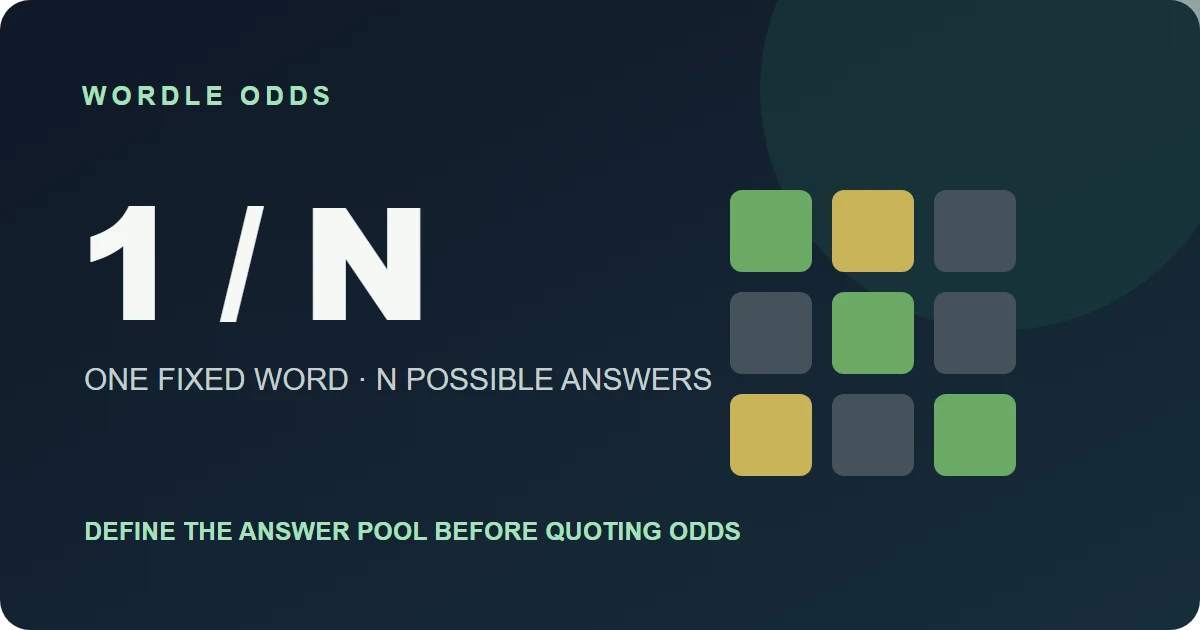
The first-try probability depends on what you mean by “guessing at random.” If a puzzle answer is modeled as uniformly chosen from N eligible answers and your fixed opening word is one of them, the model gives 1/N. With the historical 2,315-answer set used in one published Wordle analysis, that works out to about 0.0432%, or roughly 1 in 2,315.
That number is a benchmark, not a current official New York Times probability. The answer list and daily selection process are not published as a live, uniform lottery. A scheduled puzzle has one set answer; probability describes uncertainty before you know it, under stated assumptions.
If instead you choose uniformly from every legal guess, the calculation changes to eligible answers divided by legal guesses. And if you mean “how often have I personally solved on row one?”, use first-guess solves divided by completed games. Those are three different questions.
Which Wordle first-guess calculation fits your question?
Name the model before quoting a percentage. Keep the answer set, allowed-guess set, and observed games separate.
| Question | Numerator | Denominator | Interpretation |
|---|---|---|---|
| One fixed guess; uniform answer model | 1 eligible answer | N eligible answers | 1/N, only if the guess is in the answer pool |
| Fixed guess absent from answer pool | 0 eligible answers | N eligible answers | 0 under that answer list |
| Uniform random legal guess | A eligible answers | G legal guesses | A/G, if each legal guess is equally likely |
| Your recorded first-row solves | k first-row solves | n completed games | k/n is your observed rate, not a universal rate |
First define what “random first guess” means
A fixed opening word against a random answer
This is the common classroom model. Hold your opening word constant, assume the target is drawn uniformly from a known answer set A, and count whether your word belongs to A. If it does, exactly one target makes that fixed guess correct, so the model probability is 1/N where N is the number of eligible answers. If the word is not an eligible answer, the probability is zero under that list.
The calculation does not say the real game rolls a fresh random word each morning. It measures uncertainty for a reader who treats every answer in the defined set as equally possible. A real daily answer may already be selected by the game schedule; once selected, the guess is simply right or wrong.
A random legal guess against a random answer
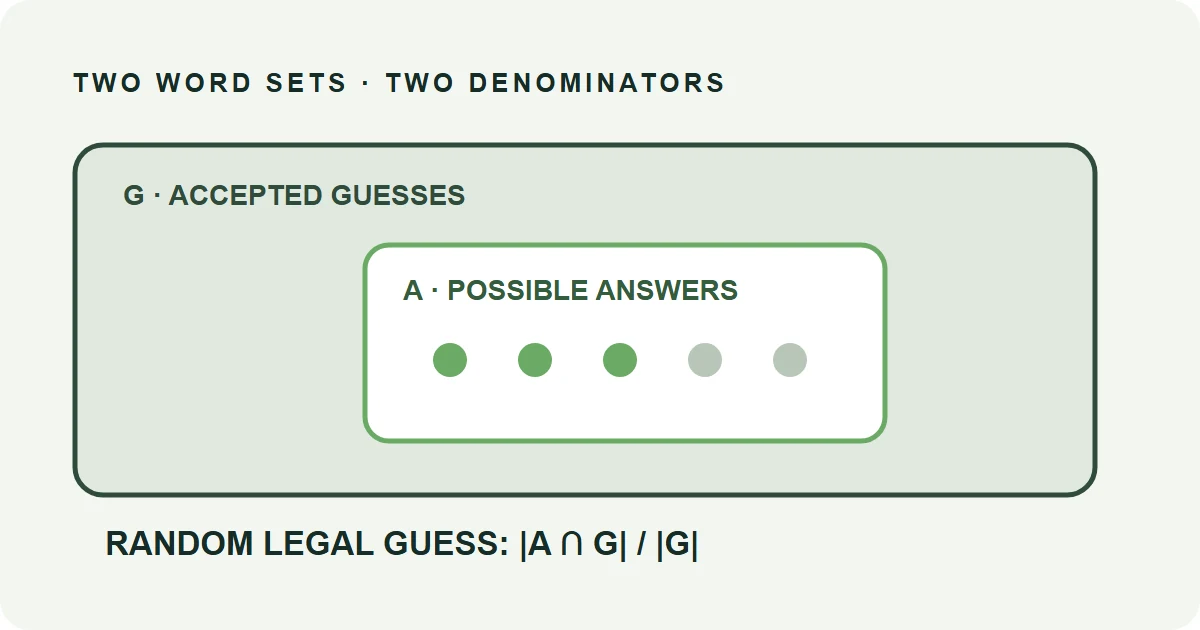
This is a different experiment: select one word uniformly from the game’s allowed-guess dictionary G, while the answer is uniformly drawn from the answer set A. Only words shared by the sets can win immediately, so the simplified rate is |A ∩ G| / |G|. When every answer is also a legal guess, this becomes |A| / |G|.
For illustration only, if a model had 2,315 answers and 10,000 equally likely legal guesses, its result would be 23.15%. Human openers are not uniform random picks: players favor familiar words and letter coverage, so this is not the chance produced by a typical strategy.
A known answer or a strategic opener is a different case
If you have already seen a spoiler, received a hint that identifies the answer, or are repeating a known puzzle, the original uncertainty model no longer applies. A correct first row after outside information is a correct play, but it is not evidence that a blind random opening has the same probability.
Likewise, a strong opener can be valuable because it reveals letters and narrows later choices. That benefit concerns the full sequence of guesses, not the chance that the opening word itself equals today’s answer. Keep “solve in one” separate from “best first word.”
How to calculate Wordle odds on the first guess
Use 1/N for one eligible fixed guess
Let N be the number of answers you are treating as possible before the puzzle, and assume each is equally likely. For a single fixed opening word that appears once in the answer set, the chance is 1 ÷ N. If a source says N = 2,315, then 1 ÷ 2,315 = 0.000431965 as a decimal, or approximately 0.0432% after multiplying by 100.
Write the assumptions beside the result: which answer list, which date or version, whether answers are equally weighted, and whether the guessed word is eligible. Without that context, “one in 2,315” looks more precise and current than the evidence supports.
- Fraction: 1 / N
- Decimal: 1 ÷ N
- Percentage: (1 ÷ N) × 100
- A larger eligible answer pool makes a fixed guess less likely to match.
Use A/G for a uniform pick from the guess list
Let A be the set of eligible answers and G the set of accepted guesses. If your hypothetical process picks uniformly from G, count the overlapping words: |A ∩ G|. Divide that count by |G|. This denominator is the number of legal guesses, not the number of possible answers.
The distinction matters because Wordle accepts words that are not selected as solutions. An answer list is a target list; a guess dictionary is an input list. Treating them as interchangeable can inflate or shrink an estimated first-try rate by a large amount.
- Answer pool A: words the model permits as targets.
- Guess list G: words the game accepts as entries.
- Overlap A ∩ G: guesses capable of matching a target in that model.
Why 1 in 2,315 is a benchmark, not today’s official rate
What the 2,315 figure describes
A 2022 Operations Research paper, “An Exact Solution to Wordle,” analyzes a fixed set of 2,315 possible solution words. That makes the set useful for reproducing the paper’s model and explaining the arithmetic. It does not certify that the New York Times currently uses the identical answer pool or chooses each answer uniformly.
Older probability articles often reuse a list from Wordle’s early period. That is useful when an article says which list it used, but it should not be presented as a live count. Strong reporting names the source, date, inclusion rule, and whether the number counts targets or all valid guesses.
- Treat 2,315 as the published model’s historical solution set.
- Do not label it the current official list without a dated first-party source.
- Do not substitute a broad accepted-guess dictionary for the answer list.
Why the denominator can change between sources
Word lists differ because they may include past answers, obscure words, offensive terms, variants, or entries that are legal guesses but never intended as solutions. Editors can also remove or add target words. A probability derived from one list therefore answers a list-specific question, not every version of Wordle.
We did not find a public, current first-party count that establishes a live denominator for the official daily game. This page therefore publishes the calculation and its assumptions instead of claiming one exact “today” percentage. Recheck primary sources before using the figure in research or reporting.
Theoretical odds and your personal Wordle stats answer different questions
A model predicts; a record describes
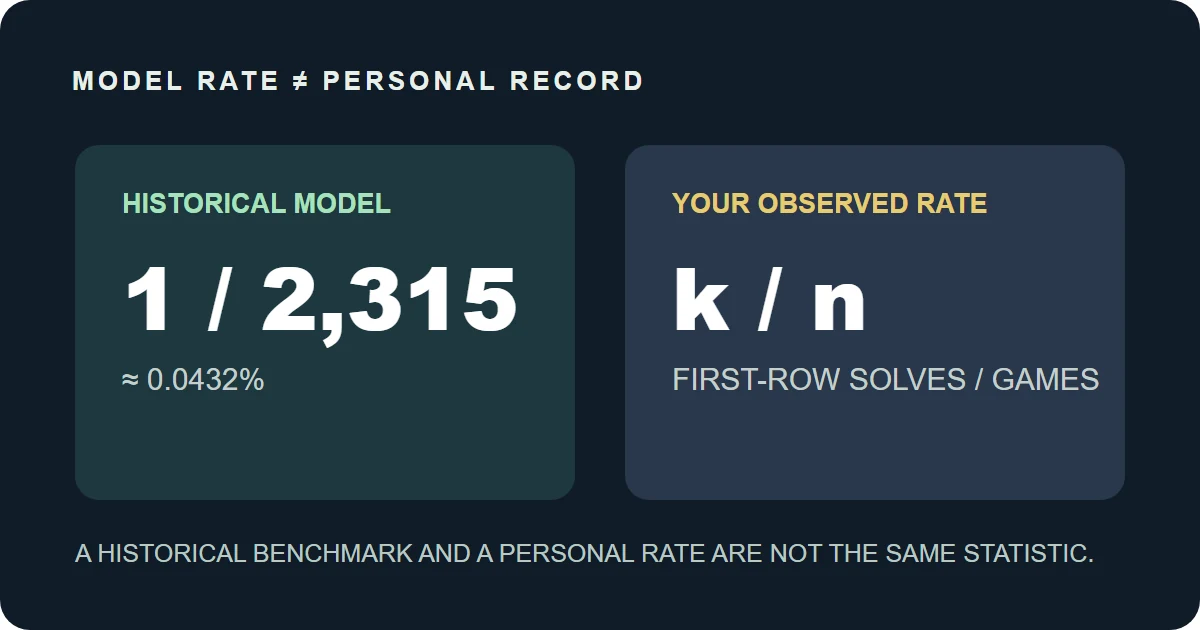
A theoretical rate starts with a defined pool and selection rule. Your personal rate is the number of games you solved on the first row divided by the number of completed games you are counting. If you solved one puzzle in one guess across 100 completed games, your observed rate is 1%; that does not prove your long-run chance is exactly 1%.
Small samples swing sharply. One exceptional result changes a 10-game record by ten percentage points, but changes a 1,000-game record by only 0.1 points. State the sample size with your percentage, and decide whether to include practice games, assisted solves, shared answers, and games where you stopped early.
Track first-row solves without overstating them
Keep one consistent denominator: for example, every daily puzzle you actually completed during the period. Count a first-row solve only when the first submitted word matched the answer. Do not mix total wins, average guesses, win streaks, or the number of games played into that numerator.
The New York Times Games help center describes player-facing statistics and sharing features. Those personal summaries can help you review play, but a private record is not a population estimate. There is no need to infer a global first-guess rate from screenshots, social posts, or a small leaderboard.
- Record first-row solves (k).
- Record completed puzzles under the same rule (n).
- Report k/n together with the dates and any exclusions.
How to read a “Wordle first try” result responsibly
A useful probability claim names its assumptions
Before repeating a percentage, ask whether the author means a fixed opening against a random answer, a random pick from every legal guess, or a personal result rate. Then check the denominator and whether the numerator is an answer word, an overlap count, or a recorded solve. These small wording checks prevent apples-to-oranges comparisons.
If two pages report different rates, first compare their word lists and models. One may use a historical answer set while another counts accepted guesses; the numbers can both be arithmetically correct and still answer different questions. Prefer a transparent method over a more dramatic headline.
- Question: What exactly is being selected at random?
- Pool: Answers, valid guesses, or completed personal games?
- Evidence: Is the list named and dated?
- Scope: Model, historical benchmark, or observed record?
Use the right Wordle page for the next question
If you want to improve after the opening guess, the strategy guide covers clue handling, letter elimination, and second guesses. If you want to summarize completed results, the Wordle calculator reports averages, win rate, and distribution. Those pages complement this explanation, but neither turns a historical answer list into a current official one.
The practical takeaway is simple: use 1/N only for one eligible fixed word under a uniform answer model; use A/G only for a uniform legal-guess model; and use k/n for your own record. Label the method and the source, then the percentage has a clear meaning.
Wordle first-guess odds FAQ
What are the odds of guessing Wordle correctly on the first try?
There is no single official current rate. Under a uniform model with N eligible answers and one fixed guess in the answer list, the rate is 1/N. Using the 2,315-word solution set in a published 2022 analysis gives about 0.0432%, or 1 in 2,315, as a historical benchmark.
Is the chance exactly 1 in 2,315 today?
That figure describes a historical solution set used in research. We did not find a public, current first-party answer-pool count that proves it is today’s official denominator, so treat it as a dated model rather than a live rate.
Are valid Wordle guesses the same as possible answers?
No. The accepted-guess dictionary can include words that are never intended as targets. A fixed eligible guess uses the answer-pool size N; a uniformly random legal guess uses the overlap between the answer and guess sets divided by the guess-list size.
Does a good starting word have a higher chance to be the answer?
A good opener is usually judged by how much useful letter information it reveals, not by how likely it is to be today’s answer. The chance of an exact first-row solve and the strategic value of an opener are separate measures.
How do I calculate my own Wordle first-try percentage?
Divide the number of first-row solves by the number of completed games included in your record, then multiply by 100. Report the sample size and use consistent rules for practice, hints, shared answers, and incomplete games.
Does solving in one prove that the odds are higher for my opener?
One result is an observation, not proof of a changed probability. A larger, consistently recorded sample is more informative, but it still describes your play conditions and does not automatically estimate every player’s or every puzzle version’s rate.